
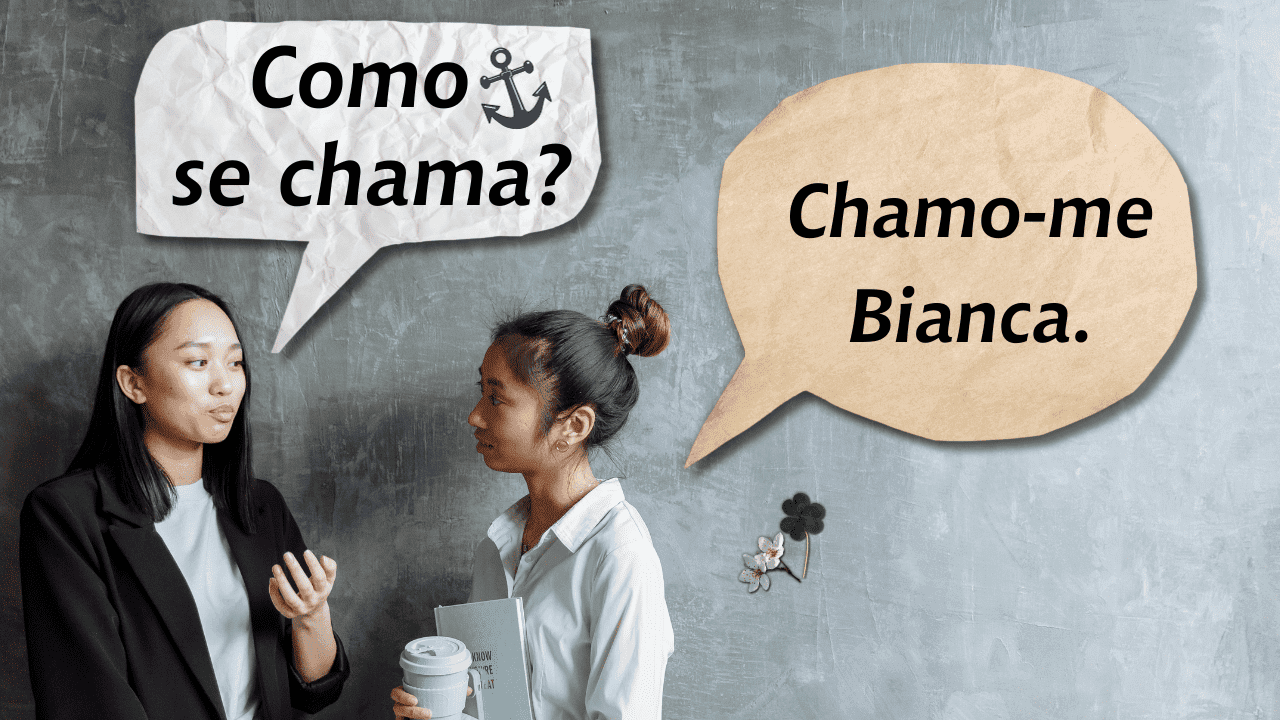
Anchor Words in Portuguese⚓is not an official term. It’s something that I call words that “anchor” the clitics before the verbs. If that just now didn’t make sense, you may want to catch up on Object Pronouns in Portuguese before you continue.
What are Anchor Words in Portuguese⚓?
Firstly, clitic placement in European Portuguese can be a complex thing to pick up. But if you want your Portuguese to sound authentic it’s worth putting in the work to get this right. For the language buffs – in Portuguese, we can have enclisis, proclisis & mesoclisis. In simple terms, the position of the clitic moves depending on whether certain words appear (or not) before them. And these certain words are what I call anchor words ⚓. When there is no anchor word, the clitic is hooked on the end of the verb through a hifen.


Secondly, knowing where they go in the sentence is something that separates European Portuguese from Brazillian Portuguese. Like Spanish, Brazilian Portuguese mostly uses proclisis (clitic in front of the verb) regardless of an anchor word. However in Portuguese, for that to happen there has to be an anchor word. Let’s look at a list of what these words are:
| não | no |
| ninguém | no one, nobody |
| nunca | never |
| nada | nothing |
| jamais | never ever |
| onde | where |
| que | what, that |
| como | how |
| quando | when |
| quem | who, whom, whose |
| porque | why, because |
| quanto/quanta/quantos/quantas | how much, how many |
| ainda | still, yet |
| também | also, as well |
| já | already |
| talvez | perhaps |
| sempre | always |
| alguém | someone |
| todo/toda/todos/todas | all |
| bem | well |
| mal | bad, barely, evil |
Anchor Words⚓ and “Yoda Speak” <(º.º)>
As I have noted above, the words in the list affect the position of the clitic in the sentence. Clitics are pronouns such as “it”, “them”, “him”, “her”, “us” etc. In Portuguese, these clitic pronouns look like: -o, -a, lo, la, -lhe, -nos, -vos, etc.
When these anchors are present with a clitic pronoun, and you translate the sentence back into English word for word, you end up sounding a little like Yoda from Star Wars. This is what I call “Yoda Speak” <(º.º)>. Next, we will look at what that looks like.
Anchor Words⚓and one verb
Secondly, and to keep it simple, we’re looking at verbs “comprar” and “comer” (to buy and to eat) in the “I” and “you” forms (formal you) and only using the clitic “it” in the masculine and singular form. (yes it can be feminine and plural as well). And we’ll use the anchor word não.
| 🇬🇧 | 🇵🇹 | Yoda Speak <(º.º)> |
| I buy it. | — | |
| I don’t buy it. | Not it I buy. | |
| You buy it. | — | |
| You don’t buy it. | Not it you buy. | |
| I eat it. | — | |
| I don’t eat it. | Not it I eat. | |
| You eat it. | — | |
| You don’t eat it. | Not it you eat. |
Exceptions
Is it the same for every verb? Yes, except for two conjugations. What? Of course, there are exceptions…it’s Portuguese.. there are always exceptions 😂😅
“ter” and “querer” have exceptions in the “you, he, she” form. Because the conjugation “them” ends in “m” the “it” and “them” clitics gain the letter “n”. So tem-no instead of tem-o. And quer gains an “e” when you hook on an “it” and “them” clitics. So “quere-o” instead of “quer-o“.
| 🇬🇧 | 🇵🇹 | Yoda Speak <(º.º)> |
| I have it. | — | |
| I don’t have it. | Not it I have. | |
| You have it. | — | |
| You don’t have it. | Not it you have. | |
| I want it. | — | |
| I don’t want it. | Not it I want. | |
| You want it. | — | |
| You don’t want it. | Not it you want. |
Lastly, there are additional rules to consider when studying clitics. These rules include spelling rules for “it” and “them” clitics if there is more than one verb. Therefore, for examples of Anchor words in Portuguese and two verbs, please visit the Object Personal Pronoun in Portuguese post and select “Clitic Spelling Rules” in the table of contents (or scroll down to it).
Let me know if you need more help with Anchor Words in Portuguese⚓. The clitics in the Portuguese language are also something many students struggle with. Mainly because on top of all the rules, it’s not always explicitly used (particularly “it” & “them”). But strangely, you need to know them to understand when one is being omitted or not. Fret not, and I’m always a message away: email or Facebook.