
Step into the vibrant traditions of New Year in Portugal! As the echoes of Christmas fade away, we gear up for an enchanting celebration filled with unique customs and superstitions. For your linguistics needs, be sure to watch the video below.
- Portuguese New Year's Eve Expressions
- A New Beginning
- The Celebration
- New Year's Eve Traditions in Portugal
- 1. 12 raisins – 12 wishes
- 2. New clothes and choosing underwear colour
- 3. Having money in your hand
- 4. Banging pan lids together
- 5. Always toast with alcohol
- 6. Kissing your other half
- 7. Watching the fireworks
- 8. Going for the first swim of the year in the Ocean
- 9. Singing the “Janeiras”
Portuguese New Year’s Eve Expressions
A New Beginning
January 1st is a festive date worldwide. Marking the end of one cycle and the beginning of a new one. This often brings with it a strong sense of motivation and hope. And also renewal and a desire to change habits that no longer serve us. Start new endeavours, and embark on new challenges. All those resolutions that end up in a drawer/bin by February for some of us 😉
No matter where you are from in the world, there are always traditions. And… superstitions in most cultures that are associated with the beginnings of new cycles. Some can be religious or they can be pagan in origin.
In Portugal, to say we have a few New Year’s Eve/Day traditions and superstitions is an understatement! But the most common ones are to eat 12 raisins, whilst the bells toll twelve. Plus wishing 12 wishes – one for each month of the year; attending a fireworks/music show; and toasting with champagne.
The Celebration
The celebration of the New Year in Portugal itself is known as Réveillon. This is usually spent in the company of family and friends. Starting with the evening meal and serving traditional foods and puddings/sweets. Lots of conversation and animation until the arrival of midnight.
New Year’s Eve Traditions in Portugal
As far as other traditions go, there are plenty of people who are quick to dismiss them. Needless to say, one person performing all rituals in 12 seconds is next to impossible. That’s right! Only 12 seconds are allotted to perform these rituals. It’s twelve because of the 12 tolls of the bell at midnight. Having said that, many people will observe at least one or two of the traditions. Some of these require some previous planning:
- Eating 12 raisins at midnight;
- Wearing a brand new item of clothing;
- Choosing the colour of your underwear for the occasion according to the wishes you want for the new year;
- Jumping off of a chair with money in your hand, pocket or shoe;
- Making noise with pot & pan lids, whistles or blowing horns to ward off negative energy;
- Jump or enter a place with your right foot;
- Turn on all lights and open all doors in your house;
- Throwing money into your house;
- Toast with Champagne or bubbly;
- Attending a fireworks show;
- Kiss your other half;
- Go for a dip in the Ocean at midnight or on the next day;
- Singing the “Janeiras”
Which Portuguese tradition will you partake in this New Year’s Eve?
Read on to learn more details on some of these traditions and some of their origins.
1. 12 raisins – 12 wishes
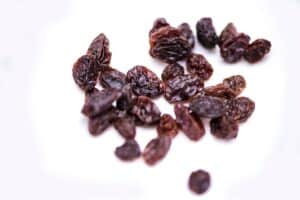
It’s said that each raisin represents one month of the year. Therefore, we get twelve wishes for the New Year. The tradition is to eat one raisin at each strike of the clock making a wish after each raisin. Some people will eat all 12 at the 1st stroke of midnight contemplating/making their wishes then. Wishes usually include hopes for good health, prosperity, happiness etc. You’ll find small bowls of raisins at Portuguese tables every New Year’s Eve. People usually start dividing them up as midnight approaches. So everyone has them ready when the bells begin to toll.
Origin of this tradition:
This one is probably the most rooted New Year’s Eve tradition in Portuguese culture and there are a few explanations of how it began. One of them is related to the fact that we follow a solar calendar, meaning a calendar based on the movement of the Earth around the Sun, which defines the year – 12 months in this case, divided into 4 seasons.
Generally speaking, we are usually taught that each raisin represents one of the twelve months of the year, and therefore we can make a wish for each raisin we eat. But in Portugal, we also follow the lunar calendar and this is also why the phases of the Moon are included in Portuguese calendars. The lunar calendar has precisely 12 days fewer than the solar calendar. So another explanation for the tradition is that the raisins represent those missing 12 days, and thus we are settling this “debt” with the Universe.
Raisins
Raisins were first used for this celebration because they are abundant at this time of year, however, there is a curious aspect related to this pertaining to our Spanish neighbours. It is said that in Spain, unlike other countries in Europe, the assigned date used to be January 6th – Kings Day.
At that time, grapes were already used by the Germans and the French as fruit eaten during the New Year. At the end of the 19th century, the Madrid City Council instituted a municipal tax so that the people were forced to celebrate on January 1st, like all the other European states. Thus, whoever was caught celebrating King’s Day had to pay a fine. Bold and defiant, many Spaniards began to gather in Plaza del Sol, Madrid’s main square, on the night of December 31, but instead of eating grapes, they would eat raisins to mock this newly imposed tradition. From then on, the “trend” of eating raisins spread through Spain and soon after in Portugal as well.
2. New clothes and choosing underwear colour

Wearing new clothes on New Year’s Eve is another big one in Portugal, particularly brand-new underwear, as it is said to bring luck and love for the New Year.
The most common colour to wear is blue as it represents luck, but knowing the meaning behind other colours may help you choose which one is more suited to your desires for the New Year 😀 Some people take this to the next level and wear more than one new item of clothing on this day. The superstition is that one must not wear tight clothes, or anything that is torn, frayed, missing buttons etc or has been mended as is perpetuates this state throughout the year. Another related superstition is that making your bed with brand-new sheets on this day will strengthen your love and improve your fortune this year.
- Azul (blue) – luck
- Vermelho (red) – passion
- Cor de Rosa (pink) – love / Romance
- Castanho (brown) – career progression
- Amarelo (yellow) – financial wealth
- Verde (green) – good health, well-being and contact with nature
- Branco (white) – peace and tranquillity
3. Having money in your hand

It’s all about the money! This one is easy to imagine why it’s so popular – money attracts money – so they say, holding money in your hand at midnight on New Year’s Day is said to attract financial wealth to you in the New Year. There are a few variations on where to hold/carry the money at midnight such as in your hands, shoes, pockets or wallet.
The tradition of notes in your shoes mainly originates from oriental beliefs, as it is believed that energy enters the body through the feet, so many people will not dispense with spending midnight with a note in their shoes. Having money in your pockets originated from the superstition that the energy associated with having empty pockets may stay with you throughout the year thus keeping your pockets empty/moneyless.
Origin
Having money in your hands as a symbol of good luck and abundance comes from another older Portuguese tradition – The Day of the Cuckoo. The date (usually March 21st) symbolized the beginning of spring seeing as the Cuckoo is a migratory bird and would return with the good weather, it meant that the time for good harvests was on the way. It was then that a ritual and a kind of competition began: The first person to see or hear a cuckoo sing should put their hand in their pocket and if they found money it was a sign that they were going to have a wealthy year and then had to let others know. Therefore, touching money at the beginning of a new phase or cycle helps to attract more money into our lives, and for that reason was carried over to New Year’s Eve as well.
If these weren’t enough, there are additional elaborate steps to take to ensure one’s good fortune for the new year in Portugal!
Some people will climb onto a chair or bench (safely) with their right foot first (commonly associated with luck) with the goal of being raised up from the ground to represent moving up in the world.
Others will then jump off the chair; hop on the floor three times on their right foot; and/or dance around a tree in the open air; all these are supposed to have the same effect (at least in theory). Don’t forget the money part!! And to top it all off there are those who make their first purchase of the year with this money to continue the cycle of good financial flow and luck.
4. Banging pan lids together
Making an awful racket by banging pot and pan lids together, blowing horns, whistles, clapping and beating on drums goes back to pagan tradition. It was the belief that the noise wards off negative energies and evil spirits from the old year. Before the times of the Roman Empire, it is said that, when there was an eclipse, people would also make noise to ward off the danger of it never returning again. So on New Year’s Eve when midnight arrives, the noise that we make is meant to disperse fear of anything that scares us and bring us the confidence that we shall continue to enjoy good health in the days to come. This tradition is stronger in the southern part of the country.
In the 50s and 60s in Lisbon, the tradition got to the point where people were flinging old dishes and pots out their windows – this practice was banned for obvious reasons. Decluttering and cleaning your house is also practised at this time as it’s considered to be a luck magnet. Every time we start a new phase it is important to let go of what no longer serves us, and remove the weight that we carry. So getting rid of old, broken things and used-up things will make space for positive renewal energy to come into our lives.
5. Always toast with alcohol

According to ancient civilizations, alcohol was considered a source of vitality and health. This is also the reason wine was considered the nectar of the gods. It is also the reason one shouldn’t toast with water; it is alcohol that symbolises life, renewal, and strength. The raisin tradition is also linked to this assumption because raisins are grapes. And wine comes from grapes, so they also represent the celebration of life. It is also said that you ought to save the cork from the bottle and only throw it out next New Year’s Eve.
6. Kissing your other half
This tradition is often associated with America. Images of couples kissing under a shower of confetti and people singing “Auld Lang Syne” (that most don’t know the words to) come to mind. It is not known for certain where this tradition began, but it is acknowledged that it is linked to a Roman festival in honour of Saturn. This festival took place at a time very close to that of the current New Year, and in which everyone kissed as an act of celebration. Many people practice this kissing ritual in Portugal and instead of confetti, it’s usually showers of Champagne, which also means good luck if you’re on the receiving end of the splatter!
7. Watching the fireworks

The tradition of launching spectacular fireworks displays is guaranteed all over the world and spans over 24 hours. Just to give you an idea, the first place to celebrate New Year’s is Kiribati (Line Islands). It’s only at 9 am in Portugal on December 31st at the time! By the time Baker and Howland Islands (in America) are celebrating it, it’s already noon on January 1st in Portugal. Hundreds of Portuguese municipalities provide pyrotechnic shows, usually associated with concerts on large outdoor stages. For many Portuguese, this is the main event of the night. For those celebrating at home, they will have their meal with friends and/or family. Then at about 11h30 pm go out and go to where the show will be taking place.
In a way, this tradition is similar to the pots and pans tradition. Fire was used by Humans in primitive times for protection to scare off ferocious animals, the cold, and darkness. It is also believed that they used it to scare off evil spirits. So, the noise and lights of fireworks are used to ward off anything that may be negative.
8. Going for the first swim of the year in the Ocean

What drives so many people to do this is on January 1st. It’s the belief that the experience hardens the bones, increases health and purifies the spirit. This tradition is mainly practised in the northern regions of the country. Places such as Carcavelos, Vila do Conde and also in Faial, in the Azores (Os Açores). This practice is more reminiscent of a rite of passage, as it implies courage and resistance, seeing as the Portuguese sea is very cold at this time of the year.
Having the will to do this brings courage and energy to face all the challenges of the coming year. Ocean water is the most purifying one that exists. Starting the year with a dip is meant to leave behind all negative energies. Additionally, it is meant to invigorate the body, the mind and, especially, the soul. The never-ending coming and going of the waves also symbolize the renewal of life, year after year.
9. Singing the “Janeiras”
Although this is a more organized group tradition, inherited from pagan traditions, it still exists today in many European countries. Nowadays in Portugal, it is practised throughout the whole month of January. It consists of groups of men and women singing on the street or door to door, wishing people a happy new year. In older days this included singing for alms and announcing the birth of Christ. The Janeiras are sung around Christmas, New Year’s and King’s Day (January 6th).
In the Algarve
In the Algarve, the tradition is called Charolas and is very much alive. The songs are about Christmas, baby Jesus, New Year’s and the Three Wise Men. Click here to read about January Traditions in Portugal.
Now that we’ve covered some of the traditions more deeply, Good Luck remembering all the steps. If in doubt, refer back to my shortlist at the top 😉 Here is a link to a video to learn how to pronounce some of the vocabulary and expressions for this celebration.
Bom ano novo a todos! | Happy new year to all!