
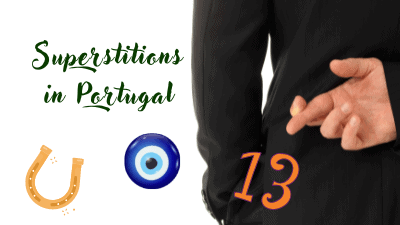
Superstitions have been around since the dawn of mankind. Although Portugal is historically a Christian country, many traditional folk superstitions have survived alongside religious beliefs. In this post, we’ll be looking at 13 Superstitions in Portugal.
- Let's look at 13 Superstitions in Portugal
- 1 – Pôr a mala no chão quer dizer perder dinheiro.
- 2 – Passar por baixo de uma escada dá azar.
- 3 – Colocar uma vassoura ao contrário, atrás da porta, fará com que uma visita chata vá embora.
- 4 – Partir um espelho significa que terá 7 anos de azar.
- 5 – Ter a orelha quente significa que alguém está a falar de nós.
- 6 – Cruzar facas dá azar.
- 7 – Nunca devem estar 13 pessoas à mesa.
- 8 – Abrir um guarda-chuva no interior de casa vai atrair problemas.
- 9 – Devemos entrar sempre com o pé direito para dar sorte.
- 10 – Ver um gato preto nesse dia dá azar.
- 11 – Varrer os pés de alguém faz com que ela nunca se case.
- 12 – No dia do casamento o noivo não pode ver a noiva antes da cerimónia para não dar azar.
- 13 – Bater três vezes na madeira afasta espíritos maus.
- Nazar
- "Fazer Figas"
- Cinco Saimão
- Ready to Improve Your European Portuguese?
The Portuguese, like many cultures, have consolidated and preserved cultural values passed down from generation to generation. A superstition is a folk belief based on a fear of the supernatural or paranormal that often results in ritualistic behaviours or specific “duties” to be followed. Whether they be religious in origin or not, they’ve endured as an uninformed way to justify the assumed randomness of inexplicable events that occur in a given context.
Let’s look at 13 Superstitions in Portugal

1 – Pôr a mala no chão quer dizer perder dinheiro.
(Putting our bags on the floor means losing money.)

2 – Passar por baixo de uma escada dá azar.
(Going under a ladder is bad luck.)
This superstition likely comes from two historical ideas.
First, in medieval Europe, a ladder leaning against a wall formed a triangle, and the triangle symbolised the Holy Trinity in Christianity (Father, Son, Holy Spirit). Walking through that triangle was seen as disrespectful or sacrilegious.
Second, there was also a very practical reason: ladders were used for construction and sometimes for executions. Walking underneath one could easily lead to something falling on you.
So what began as religious symbolism and common sense safety slowly turned into “bad luck”.

3 – Colocar uma vassoura ao contrário, atrás da porta, fará com que uma visita chata vá embora.
(Placing a broom upside-down behind the door will make an annoying visitor leave.)

4 – Partir um espelho significa que terá 7 anos de azar.
(Breaking a mirror means you will have seven years of bad luck.)
This belief dates back to the Romans, who believed mirrors reflected not only a person’s appearance but also their soul.
In Roman thought, the human body and soul were believed to renew themselves every seven years. So, breaking a mirror and damaging the reflection of your soul caused the damage to last seven years until renewal.
That’s why the superstition specifically says seven years.

5 – Ter a orelha quente significa que alguém está a falar de nós.
(When our ears burn, it means that someone is talking about us.)
I’ve also heard this additional superstition connected to ears burning:
- if your right ear is burning, then they’re speaking badly of you. The sure is to twist your ear so that they bite their tongue.
- if you’re left ear is burning, they are speaking well of you (because it’s on the heart’s side)

6 – Cruzar facas dá azar.
(Crossing knives is bad luck.)

7 – Nunca devem estar 13 pessoas à mesa.
(There should never be 13 people at the table.)
In Portugal, the superstition is that this will bring bad luck, or more extremely, death to the youngest at the table.
This belief is often linked to The Last Supper, described in the New Testament. At the final meal before the crucifixion of Jesus Christ, there were 13 people present: Jesus and the twelve apostles. One of them, Judas Iscariot, later betrayed him.
Because of this story, the number 13 became associated with betrayal and misfortune in many Christian cultures.
However, the fear of 13 may actually be older than Christianity, appearing in Norse mythology as well.

8 – Abrir um guarda-chuva no interior de casa vai atrair problemas.
(Opening an umbrella indoors will attract trouble.)
This one probably started in Victorian England when umbrellas were large, stiff and had strong metal mechanisms. Opening one indoors could easily:
- knock something over
- break fragile objects
- injure someone
Instead of explaining the mechanics to children, people simply said it would bring bad luck.

9 – Devemos entrar sempre com o pé direito para dar sorte.
(We should always enter with the right foot for good luck.)

10 – Ver um gato preto nesse dia dá azar.
(Seeing a black cat that day means bad luck.)

11 – Varrer os pés de alguém faz com que ela nunca se case.
(Sweeping someone’s feet will make them never marry.)
In Portugal and parts of Latin America, there is a superstition that if you sweep over someone’s feet with a broom, that person will never marry.
This belief often appears jokingly when someone is cleaning, and another person is standing in the way.
Historically, some folklorists think this belief might have been used as a social warning for young women, encouraging them not to spend time idly standing around during household work.
Whether true or not, it became a common saying in many Portuguese-speaking cultures.

12 – No dia do casamento o noivo não pode ver a noiva antes da cerimónia para não dar azar.
(On the day of the wedding, the groom cannot see the bride before the ceremony to avoid bad luck.)

13 – Bater três vezes na madeira afasta espíritos maus.
(Tapping/knocking on wood three times to drive away evil spirits.)
This belief likely comes from ancient pagan traditions in Europe. Many early cultures believed that spirits or gods lived in trees, so knocking on wood was a way to:
- call for protection
- Thank the spirit
- avoid attracting bad luck
Later, Christians sometimes reinterpreted the act as referencing the wood of the cross, although the original practice predates Christianity.
Do you have any superstitions in? Please let me know about any interesting ones you have in your culture or town. I’d love to hear from you.
Coming up next, I have two honourable mentions of luck and protection amulets people like to have and do.
Nazar

Many cultures share this one. The “Mau-olhado” (evil eye) or “olho-gordo” (fat eye) is the folkloric belief that an envious look or stare will bring bad luck to the person at whom it is directed. To shield oneself from this energy, one can carry or wear an amulet called “nazar” or “olho-turco” (Turkish eye). Other names for this amulet are “olho-grego” (Greek eye), or even “pedra contra o mau-olhado” (Stone against the evil eye).
“Fazer Figas”
This one is an action. It means “making figs” or making the fig sign. This gesture is in some cultures a mildly obscene one or used as an insult. But for other cultures, it’s just the children’s “I stole your nose” joke. In Portugal and many Latin cultures, it’s a symbol to ward off jealousy and attract good luck. It’s in this latter context that it becomes similar to “crossing fingers” for good luck.
It’s interesting to note that with the passing of time, the gesture is starting to fall out of use in favour of the crossing fingers gesture.


Cinco Saimão

The “Five Saimão” is a popular amulet to protect children against evil spirits and energy.
It’s usually placed on clothes, bracelets or cribs. It’s an ancient symbol of protection, composed of five symbols or charms. The Star of David, the moon, the antler, a horn and a horseshoe. They all aim to keep away enemies, envy, evil eye, and evil spirits. Additionally, they are said to invoke divine protection, luck, prosperity, and the motherly intuition of the moon.
The Portuguese have many ritualistic and superstitious beliefs surrounding the New Year, too. Click here to read about New Year’s Eve superstitions in Portugal!
Ready to Improve Your European Portuguese?
Reading about Portugal and Portuguese Tradition is great. But real progress comes from structured listening, repetition and guided practice.
Inside the Language Hub, you get:
- Audio-based lessons in European Portuguese
- Comprehension exercises
- Real-world vocabulary
- Clear explanations without overwhelming grammar
If you want to understand Portuguese beyond textbook dialogues, this is your next step.