
Viva! Discover the rich history, unique sounds, and global reach of Portuguese from Portugal. Whether you want to speak confidently or explore culture, start your journey here with me today!

Portuguese, or Língua Portuguesa, is a Western Romance language that originated in the Iberian Peninsula. More specifically, in Galicia and the County of Portugal, known as “O Condado Portucalense” or sometimes “Portugalia” in some documents.
Today, it is spoken by over 227 million people worldwide across Europe, South America, Africa, and Asia. Whether you want to connect with locals in Lisbon, Brazil, or Mozambique, understanding Portuguese opens doors to culture, travel, and communication.
Ready to start speaking? Check out our Portuguese Lessons!
Main features of the Portuguese language include:
- Portuguese is a stress-timed language. This means syllables are not enunciated with the same length, and there are stressed and suppressed vowels. This is better seen than explained in written form.
- It has an abundance of nasal sounds indicated by the letters “n”, “m” and the tilde sign ~
- Portuguese has two grammatical genders, masculine and feminine, and two grammatical numbers, singular and plural.
- There are differences in levels of formality when addressing others.
- Sentence tone level is very important as it indicates the mood and intention of the speaker like a question for example.
- Verbs have many, many inflections – over 50 forms in fact.
- Multiple negatives. – “I won’t buy nothing, nowhere.” Instead of “I won’t buy anything, anywhere.”
- There are two verbs “to be” with a third often translating into “to be” in English – the verb “ficar” (to stay/to remain).
- The typical word order is subject/verb/object, but it’s not as strict as in English. And in many sentence structures, you’ll find we do, what I like to call “Yoda Speak” (yes, Yoda from Star Wars <(º.º)>)
Curious to try speaking? Start our Absolute Beginner Portuguese Bundle today!
Present Perfect – A unique feature in the Portuguese language
A unique feature of Portuguese is its present perfect tense. It points to an action or multiple actions, starting in the past tense and will most likely continue in the future. For example:
“temos ido lá todos os dias.” will translate more accurately as “we have been going there every day (and will continue to do so)” instead of “we’ve gone there every day.”
I see many of my native English-speaking students struggle with this tense because it looks too much like the present perfect. The following sentence, “Have you seen the film?” won’t be translated into “Tens visto o filme?” but will translate correctly to “Viste o filme?” meaning “you saw the film?” (past simple) since watching a film usually implies a one-off action. If it were a series, though, you could, since that implies repetition: “Tens visto a série?” = “Have you been watching/seeing the series?”.
Declension in Portuguese
Does Portuguese have declensions? Yes, in grammatical gender (masculine and feminine) and number (plural and singular). Only personal pronouns undergo case declension (recto and oblíquo), and to some extent, contractions of prepositions with articles can also be considered declensions.
Portuguese is the sole official language of seven different countries:
Portugal, Brazil, Mozambique, Angola, Guinea-Bissau, Cabo Verde, São Tomé e Principe. And it has co-official language status in East Timor, Equatorial Guinea and Macau. With approximately 227 million native speakers worldwide, spoken across 5 continents. It is the 6th most spoken language in the world. However, only 5% of these reside in Portugal.
It’s the fastest-growing European language after English
UNESCO has estimated that Portuguese is the fastest-growing European language after English and that it has the highest potential for growth as an international language in southern Africa and South America.
Arabic influence on the Portuguese language
Although the Portuguese lexicon is 90% derived from Latin, its Arabic influences come from the Moorish occupation, which started in 711 and lasted until the end of the 15th century.
The Moors were mainly indigenous Maghrebine Berbers who converted to Islam through contact with Arabs from the Middle East. Following that, they went on to occupy the Iberian Peninsula.
Even though they were an invasive force, they were the scientific pioneers of the era and introduced many new technologies and techniques, as well as new vocabulary to describe these new things in the local cultures. These new words were adapted into Portuguese and still exist today. Most of them are easy to identify as they begin with the letters “al” like “Algarve”, others are trickier to recognise, such as “açúcar” (sugar), “cenoura” (carrot) and “xadrez” (chess).
Other international influences on the language are due to Portugal’s active role during the Age of Discovery.
Portuguese only had 23 letters up to 2009
The Portuguese Alphabet only had 23 letters up to 2009. Before 2009, the letters “K,” “W,” and “Y” were not part of the Portuguese Alphabet. All words up till 2009 with “K,” “W,” and “Y” were either foreign words or foreign proper nouns. International words like “kilo” used to be spelt “quilo” instead. But a new “Orthographic Agreement” was signed among Portuguese-speaking countries to standardise spelling forms across different variations of Portuguese and introduced the letters “K,” “W,” and “Y.”
To read more about this and learn some extra vocabulary, visit this link.
European and Brazilian Portuguese are not as similar as people might think
The difference is often compared to the difference between American and British English, but the reality is that Portuguese and Brazilian are considerably more different by comparison.

One of the key differences in the use of the second person pronoun is the informal “Tu”. In Portugal, “Tu” is commonly used, but in Brazil, it’s less commonly heard as they favour third-person pronouns such as “você”.
The syntax, grammar and vocabulary are different too. For the most part, Brazilian has fewer suppressed vowels or syllables than Portuguese. It is also more syllable-timed and not so stress-timed like European Portuguese. This makes its pronunciation and rhythm very different, as the duration of every syllable is more equal in Brazilian, and it is not the case in European Portuguese. I made a Portuguese pronunciation demonstration playlist you can watch at anytime.
One other key difference in terms of grammar is that Brazilian places object pronouns in front of verbs more similarly to Spanish, for example:
🇧🇷te amo instead of 🇵🇹amo-te” (I love you) or 🇧🇷o tenho instead of 🇵🇹tenho-o (I have it).
Another interesting difference between Brazilian Portuguese speakers is that they never seem to use “este”, “esta” or”isto” (masculine this, feminine this, this); everything is either “esse”, “essa” or “isso” (masculine that, feminine that, that).
I once saw a video of the Portuguese comedian Ricardo Araújo Pereira, giving a wonderful example of a perfectly normal sentence in Brazilian Portuguese that European Portuguese speakers would never understand (if they don’t have contact with Brazilians or Brazilian culture), even though they are using perfectly normal Portuguese words.
🇧🇷Brazilian Portuguese
“Estou parado no acostamento porque a minha perua não tem estepe.”
First, let’s look at what the literal translation is in European Portuguese:
“I’m stopped at the shoulder/support/coasting because my turkey hen doesn’t have a steppe/savana.”
What it actually means:
“I’m stopped on the side of the road because my van doesn’t have a spare tyre”
🇵🇹How it should be said in European Portuguese:
“estou parado na berma porque a minha carrinha não tem pneu sobresselente”.
Quite different, isn’t it? He goes on to say that a European Portuguese speaker will know Portuguese is being spoken, but will have no clue what’s being said. And this is so true. The first time I heard that, I had no idea what it meant before he “translated” it into European Portuguese.
Does that mean you need to avoid Brazilian Portuguese?
That depends on whether you’re a beginner in European Portuguese or not, and how often you use it in your daily life. If you are a beginner, then I would say yes – avoid – because of what I stated above. The pronunciation is too different, and you’ll be confused when European Portuguese is spoken to you. It’s the same the other way around. If you’re a beginner in Brazilian Portuguese, I would not recommend listening to European Portuguese.
But if you’re an intermediate or advanced speaker, then no, not at all. You know enough Portuguese to tell the difference (at least some of the time), and it shouldn’t influence your speaking at this point – unless you move to Brazil, of course.
Again, this depends on how much you actively speak Portuguese in your daily life.
Spanish and Portuguese – are they nearly identical?
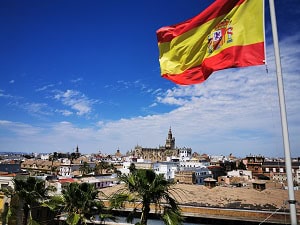
In short, yes. However, there are important differences too. They share roughly 89% of their vocabulary, but it’s the pronunciation and different sounds that separate them. Spanish has 24 phonemes, whereas Portuguese has 33.
Another main difference is that Spanish is syllable-timed (like Brazilian), and it also places object pronouns in front of the verbs:
“lo tengo” (I have it in 🇪🇸) vs “tenho-o” (I have it in 🇵🇹)
These last two differences make it so that many times Brazilians will understand certain Spanish dialects quicker than they would European Portuguese. How funny is that?
There are also many cognates (false friends) that do not mean the same thing and can lead to embarrassing situations. There is also a vastly different vocabulary for things:
| 🇵🇹Portuguese | 🇪🇸Spanish | 🇬🇧English |
| faca | cuchillo | knife |
| óculos | gaffa | glasses (for eyes) |
| joelho | rodilla | knee |
Interestingly, the continuous tense in Spanish is closer to Brazilian Portuguese than European Portuguese because of its wide use of the gerund.
Spanish also exclusively uses the verb “haver” as an auxiliary verb, whilst Portuguese uses “ter” instead. Knowing Spanish can help you with learning Portuguese, but it can hinder you too, and you may end up speaking a version of “Portuñol” or “Spantuguese” in English 😉
I hope you enjoy your experience learning the Portuguese language and I wish you good Luck! You can always reach out to me personally or join our group here.