
January in Portugal is a month of new beginnings, winter traditions and the final celebrations of the Christmas season. From Dia de Ano Novo and Dia de Reis to the traditional singing of Janeiras, January offers plenty of opportunities to discover Portuguese culture while learning useful European Portuguese vocabulary.
🌦️ Weather in Portugal in January
January is one of the coldest months of the year in Portugal, but winter weather varies considerably from north to south. The north of Portugal is generally cooler and wetter, while the Algarve usually enjoys milder temperatures and more sunshine.
Rain is possible throughout the country, particularly in the north, while sunny winter days are common in the south. Even when temperatures are mild during the day, mornings and evenings can feel quite cold.
January is therefore a useful month for learning everyday weather vocabulary such as frio (cold), chuva (rain), sol (sun), nublado (cloudy) and temperatura (temperature).
🎉 New Year in Portugal
January begins with Dia de Ano Novo (New Year’s Day), following the celebrations of Noite de Ano Novo (New Year’s Eve). Families and friends often get together to welcome the new year, enjoy a special meal and make wishes for the year ahead.
New Year’s celebrations are also a useful opportunity to learn expressions such as Feliz Ano Novo! and Bom Ano!
👑 Dia de Reis – 6th January
Dia de Reis, or Epiphany, is celebrated on 6 January and traditionally marks the end of the Christmas season. In Portugal, the day is associated with customs such as eating bolo-rei and singing Janeiras.
The tradition of cantar as Janeiras involves groups of people going from house to house singing traditional songs and wishing people a happy new year.
🎶 Janeiras – A Portuguese January Tradition
As Janeiras are one of Portugal’s best-known January traditions. Groups of singers traditionally visit homes in their local community, singing songs and offering good wishes for the new year. In return, they may receive food, drink or other small gifts.
The tradition varies from one region to another, making it a wonderful way to explore both Portuguese language and culture. You may also hear the expression cantar as Janeiras when talking about this tradition.
🌸 Almond Blossoms in the Algarve
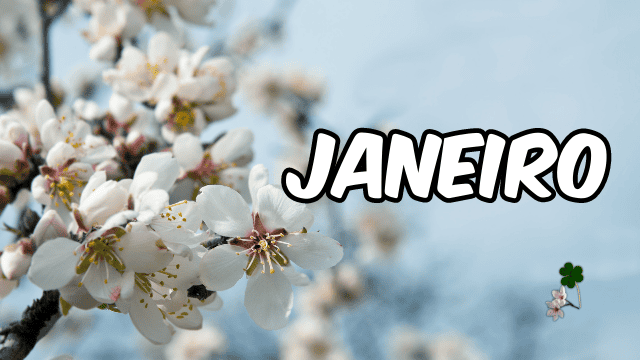
January can also bring the first signs of spring to the Algarve. From around January onwards, almond trees may begin to bloom, filling parts of the Algarve countryside with delicate white and pink blossoms.
The almond blossom is closely connected to one of Portugal’s most famous legends: the Legend of the Almond Blossoms. According to the legend, a northern princess missed the snow of her homeland, so her Moorish husband planted almond trees across the Algarve so that, when they blossomed, their white flowers would look like snow.
Today, the almond blossom is one of the most beautiful signs of the changing season in the Algarve and an important part of the region’s cultural identity.
💬 Portuguese Vocabulary for January
- janeiro – January
- o Ano Novo – New Year
- o Dia de Ano Novo – New Year’s Day
- a Noite de Ano Novo – New Year’s Eve
- o Dia de Reis – Epiphany
- o bolo-rei – King’s Cake
- as Janeiras – traditional New Year’s songs
- cantar as Janeiras – to sing the Janeiras
- a amendoeira – almond tree
- a amendoeira em flor – almond tree in bloom
- o inverno – winter
- o frio – cold
- a chuva – rain
- o sol – sun
- nublado – cloudy
If you’re learning European Portuguese, January is a great month to expand your vocabulary while discovering Portuguese winter traditions, regional culture and the first signs of spring in the Algarve.