
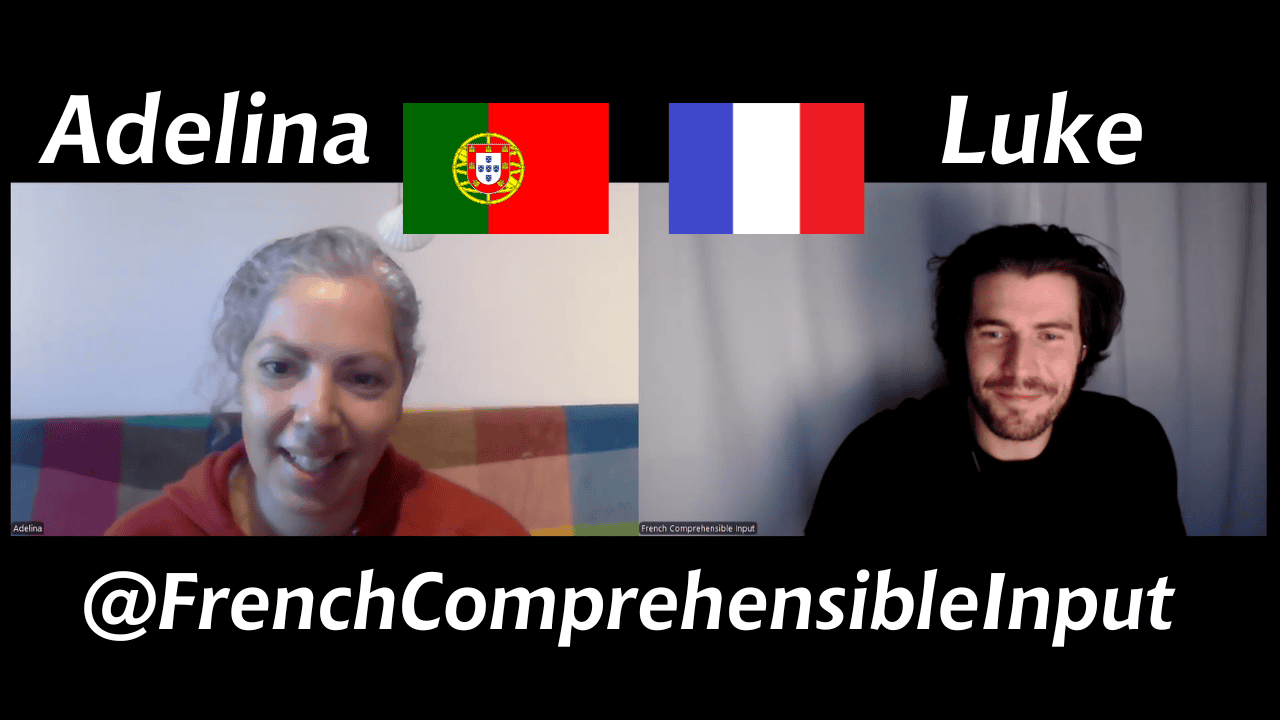
In this video, we practise Portuguese with Luke, a polyglot passionate about languages, who is currently learning European Portuguese.
In this video, we chatted about:
🟠 Where Luke lives – and how to correctly say na Suíça (“in Switzerland”) in Portuguese.
🏙️ Life in Geneva – the pros and cons of living in a city like this.
🗺️ How many languages he speaks (five!) and which ones.
🇷🇺 What it’s like learning Russian and what makes it different from other European languages.
🎯 Luke’s dream of working with languages in the future.
🇵🇹 The difference between bom apetite and bom proveito in Portuguese.
🔢 How gender works with numbers 1 and 2 in Portuguese (yes, numbers change depending on whether the noun is masculine or feminine!).
😄 And a few honest confessions – like how even as a fluent French speaker, sometimes the grammar rules of his own language still confuse him!
Video
📝 Grammar Tip – “Viver” vs “Morar”
Both viver and morar can be used to say you live somewhere, but there’s a slight difference in nuance:
- Morar is used when you’re referring to where you reside physically. It’s more about location.
➤ Eu moro em Lisboa. = I live (reside) in Lisbon. - Viver can also refer to an experience or lifestyle. It’s often used more broadly.
➤ Eu vivo em Lisboa. = I live in Lisbon (as in, I have my life there).
They’re often interchangeable, but morar is more common when talking about your home address or city (think morada), while viver might be used in deeper or more poetic contexts (e.g. viver bem, viver em paz, viver em Portugal).
🌍 Countries That Take an Article in Portuguese
Some country names in Portuguese are preceded by a definite article (o or a), while others are not. Here are a few examples to keep in mind:
With an article:
- a Suíça (Switzerland)
- a França* (France)
- a Alemanha (Germany)
- a Espanha* (Spain)
- a Itália* (Italy)
- a Inglaterra* (England)
- a Bélgica (Belgium)
- o Brasil (Brazil)
- o Japão (Japan)
- o Canadá (Canada)
- os Estados Unidos (the United States)
*These are optional and can be used without the articles as well.
Without an article:
- Portugal
- Andorra
- Moçambique
- Angola
- Timor-Leste
- Israel
This matters when you’re forming sentences with prepositions like em (in/on/at) and de (of/from).
- Struggling with Portuguese prepositions? Check out this free mini-course for beginners
🎯 This video is perfect for:
✅ A2-B1 Portuguese learners
✅ Anyone who wants to hear slow, authentic European Portuguese
✅ Language lovers and polyglot fans
👉 Watch, learn, and don’t forget to comment on your favourite word or expression in Portuguese!