
What are the impersonal expressions in Portuguese? If you’re learning the language and have progressed beyond the beginner stages, you’ve no doubt come across this term already. These are the expressions used with some of the subjunctive tenses and the personal infinitive tenses. They are easy to spot because they start off the sentence with “ser” followed by an adjective, and, in the case of the subjunctive, there will be “que” after the adjective. So let’s find out more about what all that means.
Lesson
How impersonal expressions are made
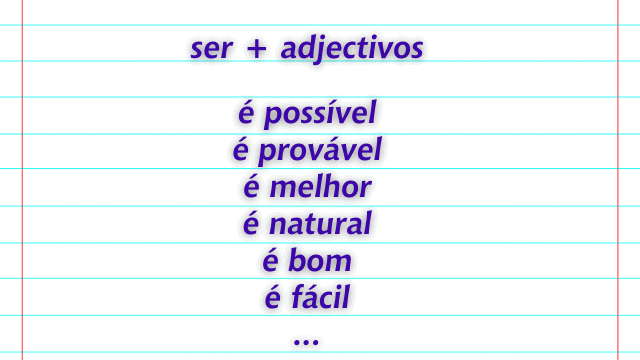
As I mentioned in the intro, these expressions start with “ser” followed by an adjective and then, in the case of the subjunctive tenses, followed by “que” (that). To compare this with English, it’s when we start sentences with “it’s/it is” followed by a description, and then “that” (for example: it’s good that we go now).
| Conjuntivos |
| ser (é) + adjectivo + que |
| Infinitivo Pessoal |
| ser (é) + adjectivo |
Which tenses use impersonal expressions?
- Presente do Conjuntivo (Present Subjunctive in Portuguese)
- Imperfeito do Conjuntivo (Imperfect Subjunctive in Portuguese – Hypothetical Future in the Past or expressed in the past)
- Pretérito Perfeito Composto do Conjuntivo (Compound Hypothetical Completed Action – tenha feito)
- Pretérito Mais-Que-Perfeito Composto do Conjuntivo (Compound Hypothetical Past within the Past – tivesse feito)
- Infinitivo Pessoal (Personal Infinitive)
Presente do Conjuntivo with Impersonal Expressions
This is the tense we use after verbs in the main clause that express doubt, wishes, desires, will and emotion, followed by the linking word “que” (that). The main post for this tense is here. Below are some examples of this tense used with the impersonal expressions specifically. For the pronunciation of the sentences below, watch this video demonstration or the video below the examples.
É importante que eles conheçam novos amigos.
It is important that they meet new friends.
Não é necessário que ele escreva um texto elaborado.
It is not necessary that he writes an elaborate text.
Não é claro que eles cheguem amanhã.
It isn’t clear that they arrive tomorrow.
É necessário que tu estejas bem.
It is necessary that you are ok/well.
É considerado importante que o Alberto faça desporto.
It is considered important that Albert practices sport.
Não é possível que ele vá à praia esta tarde.
It isn’t possible that he goes to the beach this afternoon.
É interessante que tu toques piano.
It is interesting that you play the piano.
Não é bom que sejam eles a pagar.
It is not good that it be them to pay.
É melhor que nós paguemos a conta.
It is better that we pay the bill.
É bom que ele queira vir connosco.
It is good that he wants to come with us.
É útil que tenhamos dois carros.
It is useful that we have two cars.
Watch the demonstration of the spoken form of these examples in the video below.
Imperfeito do Conjuntivo with Impersonal Expressions
This tense is the one we use to express a future that was hypothetical or wished for in the past that didn’t come to pass – an “it would have been” type of sentence. It’s also used to express a hypothetical future but, expressing it in the past tense – an “it would be” type of sentence. When used with impersonal expressions specifically, “ser” is in the past tense. Next are some examples of this use. For the pronunciation watch this video demonstration. The translations are more on the literal side and may sound a little awkward at times in English. I chose to write them this way so you can get a better feel for what’s happening in this tense in Portuguese.
Era provável que ela chegasse tarde. (It was probable that she would arrive/arrived late)
Era possível que pagassem as contas depois. (It was possible that they would pay/paid the bills afterwards)
Era importante que eles partissem muito cedo. (It was important that they would leave/left very early)
Era melhor que ela comprasse outro casaco. (It was better that she would buy/bought a new coat)
Era conveniente que elas chegassem agora. (It was convenient that they would arrive/arrived now)
Era preferível que não chovesse no dia da festa. (It was preferable that it wouldn’t/don’t rain on the day of the party)
Era bom que visses o filme. (It was good that you would see/saw the film)
Era natural que ele não quisesse vir. (it was natural that he would not/didn’t want to come)
Era fundamental que não perdessem o comboio. (It was fundamental that they wouldn’t/don’t miss the train)
Era difícil que ele falasse sobre isso. (It was difficult that he would speak/speak about that)
Pretérito Perfeito Composto do Conjuntivo with Impersonal Expressions
This tense expresses a hypothetical completed action using the helping verb “to have”. More details on this tense are here. And below are examples of this tense using impersonal expressions. Click here for the pronunciation.
É possível que ela tenha ido para o trabalho.
It’s possible that she has gone to work.
É melhor que tenham feito os trabalhos de casa.
It’s better that you (all) have done your homework.
Não é verdade que ele tenha dito isso.
It’s not true that he has said that.
É importante que tenham descansado bem.
It’s important that they have rested.
Não é óbvio que tenhas gostado disso.
It’s not obvious that you have liked that.
É agradável que me tenham visitado.
It’s nice that you (all) have come to visit me.
É interessante que tenhas gostado do filme.
It’s interesting that you have liked that film.
Não é bom que tenham feito isso tão depressa.
It’s not good that they have done that so fast.
É fundamental que não tenhas ficado nervosa.
It’s fundamental that you have not become nervous.
É conveniente que tenham vindo agora.
It’s convenient that you (all) have come now.
Watch the pronunciation demonstration of the spoken form of these examples.
Pretérito Mais-Que-Perfeito Composto do Conjuntivo with Impersonal Expressions
Era bom que o Filipe tivesse ido.
It was/would be good if Filipe had gone.
Foi óptimo que o Filipe tivesse ido.
It was great that Filipe went.
Era importante que tivessem feito o trabalho.
It was/would be important that they had done the work.
Seria mau se tivessem lido em voz alta.
It would be bad if they had read it out loud.
Foi difícil que eu tivesse dito isso.
It was hard that I said that/It was hard for me to say that.
Foi interessante que tu tivesses vindo à minha casa.
It was interesting that you came to my house.
Seria bom que tivessem comido nesse restaurante.
It would be nice if you had eaten in this restaurant.
Era agradável que tivessem oferecido isso.
It was/would be nice that they offered that.
Foi melhor que vocês tivessem pagado o jantar.
It was better that you paid for dinner.
Seria preferível que tivessemos trazido o carro.
It would be preferable that we brought the car.
Infinitivo Pessoal with Impersonal Expressions
to be continued… (this post is a work in progress)