

The Present Subjunctive in Portuguese (Presente do Conjuntivo) is used in complex sentences and after the linking word “que”* and is dependent on the main clause. This main clause will always express a wish, doubt, emotion, uncertainty or belief.
*(there is a handful that doesn’t use “que“)
Lesson
How to Conjugate the Present Subjunctive in Portuguese
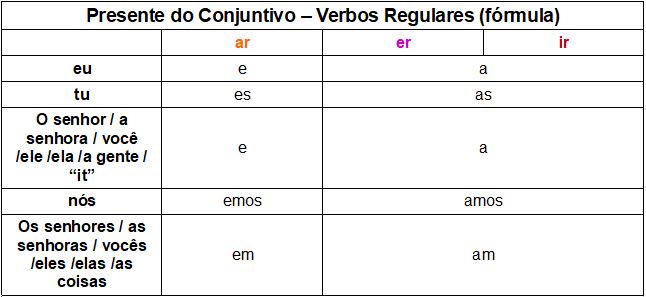
You’ll be relieved to know that some of these conjugations will be familiar, especially if you have already learned the imperative. If not, no worries, the present subjunctive in Portuguese is easy to conjugate (for regular verbs). In a way, the formula is the opposite of the normal present tense. So, for an “AR” verb, you take the “ar” off the infinitive and add an “e” (instead of an “a” like in the indicative present tense), then proceeded with the typical endings for the respective grammatical person (s for tu, mos for we and m for they). For “ER” and “IR” verbs it’s the other way around, you replace the ending with an “a” (instead of an “e”) and then add the typical endings for the respective grammatical person (s for tu, mos for we and m for they).
Secondly, you’ll also be happy to know that the conjugation for “you(formal)/he/she/it” is the same as the “eu” form. So that’s one less conjugation to learn 😀
Let’s have a look at the formula and a few examples below:
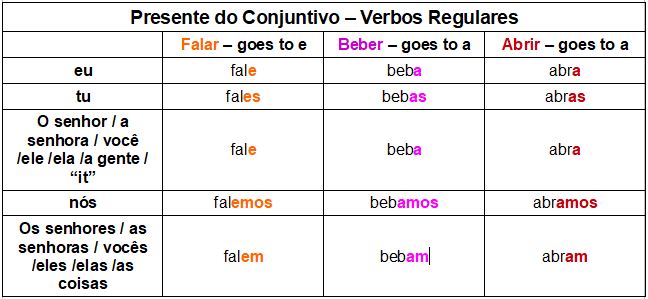
The next table has some easy examples of how to apply the above formula:
And now let’s look at some other verbs and how they are affected by this tense.
Some of the regular verbs need to have their spellings adjusted so that they still follow the Portuguese pronunciation rules. Having said that, they ultimately still follow the rule: AR goes to e and ER/IR goes to a. These are the verbs whose infinitive forms end in “car“, “çar”, “cer” and “gar”.
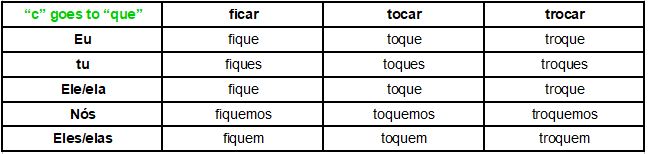
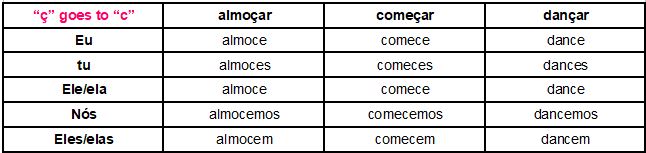
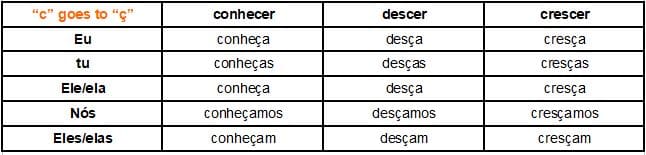
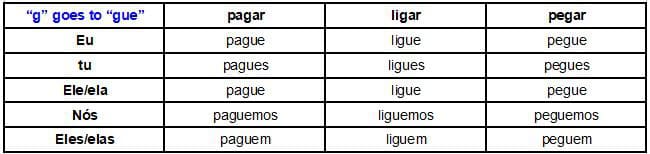
Regarding irregular verbs in this tense, the best way to get to their conjugations is to look at what the “eu” form is in the normal present tense and then change the ending from there. We do the same as if we were conjugating the Imperative. For example the verb “fazer”.
“I do” = “faço”
So now I change that “ço” ending to “ça” and I get “faça”. It’s from this root that I continue the conjugations. Let’s have a look at what that looks like:
| eu | faça |
| tu | faças |
| ele/ você/ o senhor /etc | faça |
| nós | façamos |
| vocês/eles | façam |
Now that you know how to apply this step, let’s look at some of the most used irregular verbs in the Present Subjunctive in Portuguese.
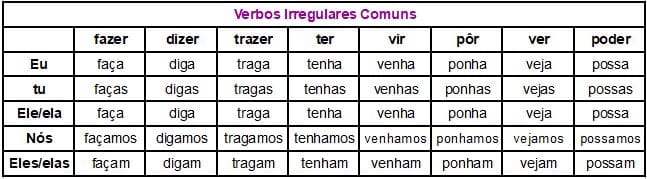
And then there are some irregular verbs that are a little more irregular and are not formed the same way as before. They do their own thing and must be learned on their own.
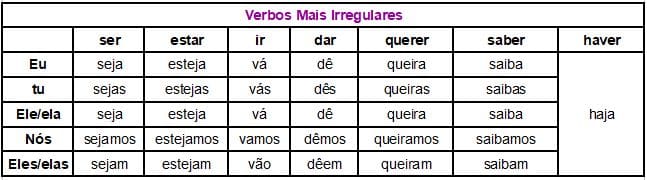
When is it used?
As mentioned in the intro, the present subjunctive in Portuguese is used to express a wish, doubt, emotion, uncertainty or belief. So we use it for actions that are plausible but have not occurred yet. As with all subjunctive tenses, the presente do conjuntivo is used in complex sentences. This means you’ll use this tense in subordinate clauses (sentences that depend on another sentence). You’ll also be happy to know that there are specific expressions and words that “trigger” the present subjunctive in Portuguese.
The Present Subjunctive in Portuguese will follow: (this list is still under construction)
- Impersonal expressions
- Main clauses that express a wish, desire, emotion, doubt and will
- Talvez (perhaps)
- Embora/mesmo que/se bem que/nem que/ainda que
- Antes que/até que/logo que
- A fim de que/para que
- A menos que/a não ser que/sem que/desde que/caso
- Oxalá/tomara que/quem me dera que/Deus queria que
- Relative subordinate clauses
- Expressing opinions, facts and evidence
- Por mais que/por muito que/por pouco que/por maior que/por pior que
- Onde quer que/quem quer que/quando quer que/etc
We also use it in “would you like me to…” type questions. We actually don’t say “would you like me to ______” we say: “Do you want that I ______”. For instance:
“Would you like me to call him?” we say “Do you want that I call him?”
“Queres que (eu) lhe ligue?”
Because Portuguese is a null subject language, the “eu” doesn not need to be explicit

Impersonal Expressions
As we saw in this post, these impersonal expressions are easy to spot because they start off the sentence with “ser” followed by an adjective and, in the case of the subjunctive, there will be “que” after the adjective.
É importante que eles conheçam novos amigos.
It is important that they meet new friends.
Não é necessário que ele escreva um texto elaborado.
It is not necessary that he writes an elaborate text.
Não é claro que eles cheguem amanhã.
It isn’t clear that they arrive tomorrow.
É necessário que tu estejas bem.
It is necessary that you are ok/well.
É considerado importante que o Alberto faça desporto.
It is considered important that Albert practices sport.
Não é possível que ele vá à praia esta tarde.
It isn’t possible that he goes to the beach this afternoon.
É interessante que tu toques piano.
It is interesting that you play the piano.
Não é bom que sejam eles a pagar.
It is not good that it be them to pay.
É melhor que nós paguemos a conta.
It is better that we pay the bill.
É bom que ele queira vir connosco.
It is good that he wants to come with us.
É útil que tenhamos dois carros.
It is useful that we have two cars.
Watch the demonstration of the spoken form of these examples in the video below.
to be continued…