

I know that grammar lessons can be tough and unappealing. Perhaps reading And reading Invariable Demonstrative Pronouns in Portuguese may have shut you down. But I will try my best to keep it simple. Isto, isso and aquilo are certainly up there in the difficulty level when first learning Portuguese. If you were looking for adverbs of place then click advérbios de lugar (adverbs of place).
What’s a Demonstrative Pronoun?
A demonstrative pronoun is a word (pronoun) that represents another word (noun) and indicates its position as being near or far, including in time. These are the words “this,” “that,” “these,” and “those.” In English, they are connected to their noun by number: “this” and “that” for singular and “these” and “those” for plural.
This all seems simple enough, right? But wait! Here comes Portuguese and things start to become a little more complicated.
Almost all pronouns in Portuguese are connected to their nouns by number and ALSO by gender. But there are a few that aren’t – which are the stars of this lesson: isto, isso, and aquilo. These are used when the gender of the noun is unknown or indeterminate.
Isto Isso Aquilo
At first, they seem easy as they have no plural or gendered forms. This is why they are called invariable: they never change regardless of gender and number. So let’s see how they work.
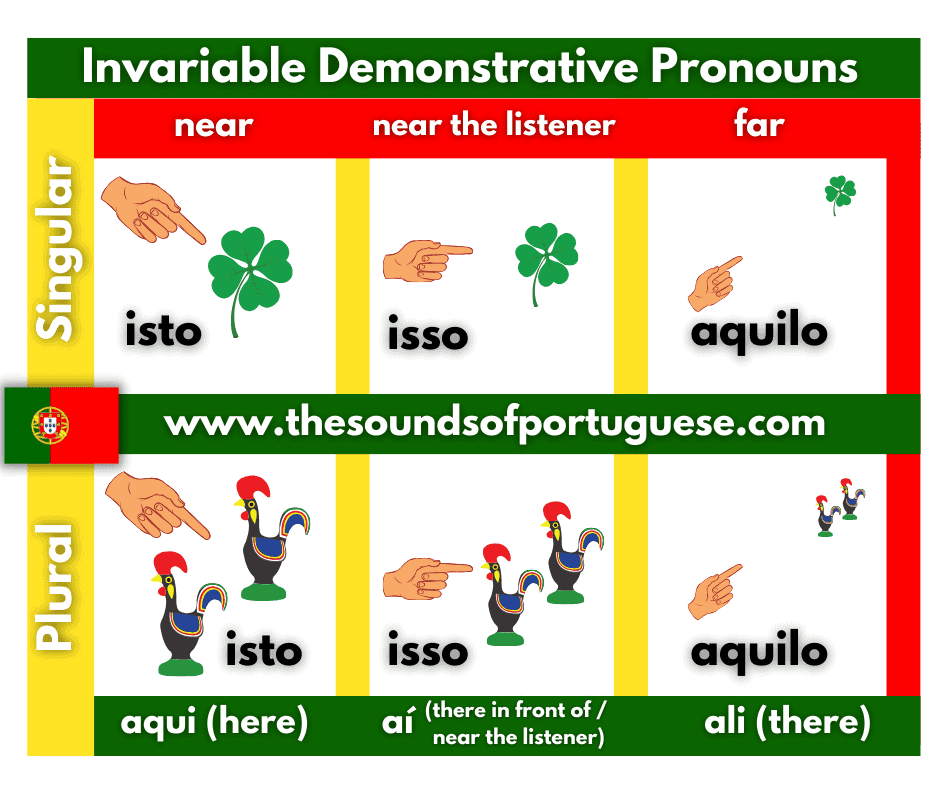
Isso vs Aquilo
Ok, so now you’re wondering “Wait a minute, are isso and aquilo interchangeable?”
Unfortunately, no.
Which one you use will depend on where or when they are to the speaker and the listener at the time of the conversation. So it’s always a good strategy to practice these in tandem with the correct adverbs of place (there, over there). In Portuguese these are: “aí” (there close to you) and “ali” (there / over there). If you are unfamiliar with these then I have this lesson here which goes into detail about them.
Putting it all Together
Going back to the demonstrative pronouns, this means the word “isto” is always used to determine that something is close to the speaker (here). If I say “O que é isto?” (what is this?) I’m referring to a thing that is HERE near me.
Me: O que é isto? (what is this?)
Also me: Isto é um lápis. (This is a pencil.)

The word “isso” expresses “that”, but with a twist. It’s a “that” that is near the listener and far from the speaker. In other words, if you and I are standing apart or on the phone with each other, it’s “there” near you and not me. Confused yet? No bother, let’s break it down further. To use isso properly the situation should be something like this:
Me: What is that? (there near you / in front of you)
You: This (here near me) is a pen.
Now let’s see that interaction in Portuguese:
Me: O que é isso?
You: Isto é uma caneta.
If you thought this was confusing before…wait! There is MORE. Keep in mind that this can happen in reverse too!! If someone asks you “O que é isso?” now you are the listener and they are referring to an object that is near you and not them.
So in short your “isso” will always be the other person’s “isto” and their “isso” will always be your “isto”.

Let’s continue.
The last one in this group is “aquilo” which means “that” (over there) – it’s far from both the listener and the speaker. Easy, right? This one is straight forward just like “isto”. Think of “aquilo” as having “over there” incorporated into it.
Me: O que é aquilo? (What is that over there?)
You: Aquilo é um avião. (That over there is a plane.)

But don’t sigh in relief just yet. We haven’t looked at the VARIABLE demonstrative pronouns yet. But I shall torture you no more today. And on that note, I will leave you with a few more examples below and I shall see you in the next post!
Examples:
O que é isto? (What is that? Near the listener)
Isso é o carro do Pedro. (That is Pedro’s car.)
O que é aquilo? (What is that? Over there)
Aquilo são os sapatos do Mário.