

Por is used to express movement through, cause, or means, while Para is used to express destination, goal, or purpose.
Examples:
- Vou para casa → I am going home (destination)
- Envio por email → Sent by email (cause/means)
| Preposition | Meaning | Example |
|---|---|---|
| Para | Destination / Goal / Purpose | Vou para casa |
| Por | Movement through / Cause / Means | Envio por email |
The quickest way to finally clear up this confusion is: stop thinking of por and para in Portuguese as “for”. I know that sounds confusing because when you translate for into Portuguese, you do end up with para (sometimes por)…
But that’s exactly the problem!
When you translate Portuguese sentences with por and para back into English, you often get different translations, and none of them is “for”.
Moreover, when you’re trying to use “for” in Portuguese, you end up wondering which one it is. When do we use por and when do we use para? Keep reading this ultimate guide to por and para in Portuguese to find out how to solve this mystery.
If you’re looking for the beginer free course on prepositions, then click here.
Por vs Para in Portuguese – The Difference Explained
“For”, just like por and para is a type of word called a preposition. The trouble with thinking that por and para only mean “for” comes when you translate Portuguese back into your native language. You end up with a multitude of translations (prepositions in this case) that you didn’t expect. This happens because in your native language, you don’t use that preposition in those contexts.
One simple change in your approach is the key step to learning and sorting this out. Work with these two words in the opposite direction that you’ve been doing. When going from your native language to Portuguese, you also need to work it backwards, from Portuguese back to your native language.
Common Por vs Para Mistakes
one: stop thinking of por and para as only meaning “for”
two: por and para are not interchangeable
three: stop thinking that one is some kind of an exception to the other or
One of them is used less than the other.
How to Learn Por and Para in Portuguese (Tips for Beginners)
Really learn when each one is used in Portuguese. To help you with this, from now
onwards when you think of para think of an arrow➜ and when you think of por try
to visualise a road➖ or a set of scales⚖️.
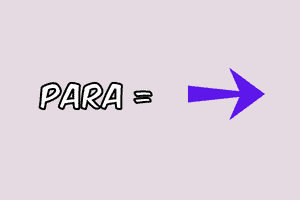
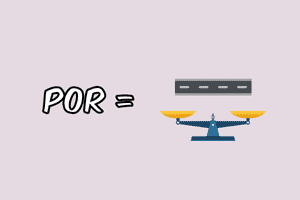
Por vs Para Visual Tricks: Arrow, Road, and Scales
Para is always used in situations when we’re referring to:
- deadlines
- targets
- destinations
- recipients
- purposes
- goals
- results
- times missing until and also
- pointing to someone’s opinions or experience of something
The arrow➜ helps you remember that these are all scenarios in which you can imagine an arrow as pointing to these things.
Por is used to refer to:
- by what means something is done
- by whom something is done
- via what something is done
- through/over
- lengths of time
- exchanges of any kind of values or reasons or behaviours
The best way to understand the analogies and their uses is to look at lots of examples, such as the ones in this video where I go into detail on these uses.
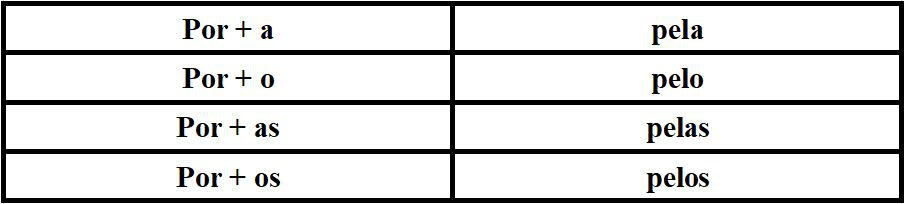
There is only one other thing that you need to know about specifically is that when you use por before a noun (thing/name) that actually comes with a definite article (the), then por contracts (which means it joins into one word with that article). Read on to understand this further.
What’s a definite article?
In short, it’s the Portuguese word for “the” but Portuguese has 4 different versions.
The four definite articles:
- masculine singular (o)
- feminine singular (a)
- masculine plural (os)
- feminine plural (as)
How do you know what’s Masculine and what’s Feminine?
That’s all explained in Portuguese Definite Articles.
Back to the lesson at hand. So because we have four articles, we’re going to end up with four contractions for por:
Para does NOT suffer contractions in the written form, but it may in the spoken form. This will depend on the region, accent and formality of the conversation. You may sometimes hear:
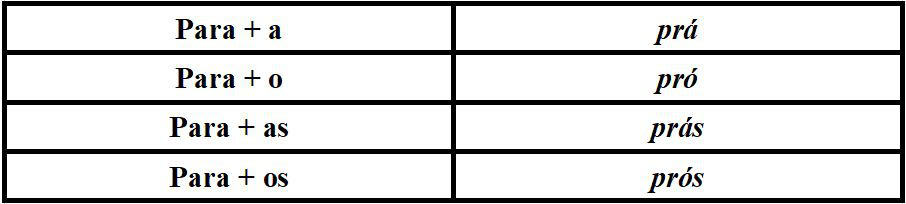
That’s all the theory. The next and most important thing is to look at many examples. Expose yourself to the language and try to understand how por and para fit into the arrow and scales analogy.
Watch the video below for the examples and the pronunciation! And print off this free guide sheet to help you. You got this! Don’t forget to try out the quiz or practice.
