

In this post, we’re looking at the Possessives Portuguese. They are used to show ownership. They indicate who the owner of a specific thing is or indicate a relationship between two people (and things too). There are actually two grammatical classifications for these words: pronouns and determiners and then another group of possessives. In this lesson, we will sort through all that is explained in steps.
Possessive Pronouns and Determiners
As I mentioned in the intro, there are two grammatical classifications for possessive words: pronouns and determiners. Even though they take the same forms in Portuguese (see tables below), the difference is if they accompany OR replace the noun. If they accompany the noun they are called determinantes (determiners) and if they substitute the noun then they are called pronomes (pronouns). This being so, it’s not something foreigners learning Portuguese need to know to this level of grammatical detail. But for the language buffs here are some examples:
🇬🇧English: My pen is red. (my = determiner – because it accompanies the noun pen)
🇵🇹Portuguese: A minha caneta é vermelha. (minha = determinante)
Now let’s see when the determiner becomes a pronoun:
🇬🇧English: My pen is red, yours is blue. (yours = pronoun – because it has replaced the noun pen)
🇵🇹Portuguese: A minha caneta é vermelha, a tua é azul. (tua = pronome)
Possessives are Gendered
In Portuguese, the possessives have feminine, masculine, singular and plural forms. Why they vary this way has to do with the grammatical gender of the thing being possessed and not the person that owns it. You’ll note that the two tables below only have variances in English because in Portuguese they take the same form.
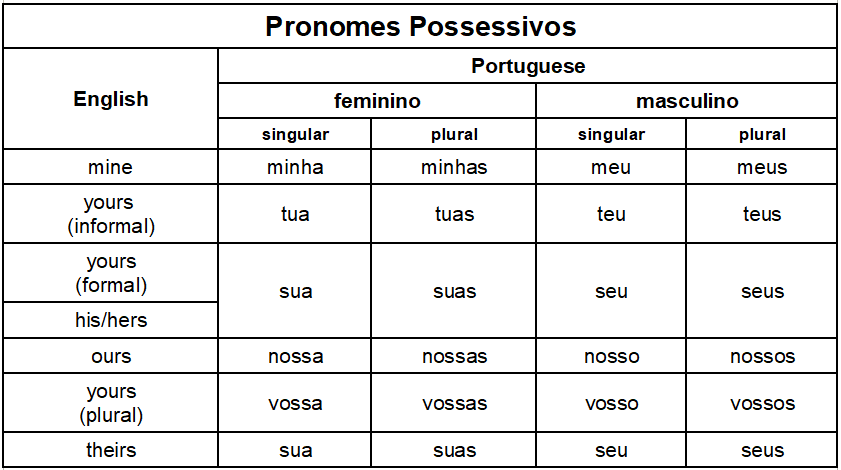
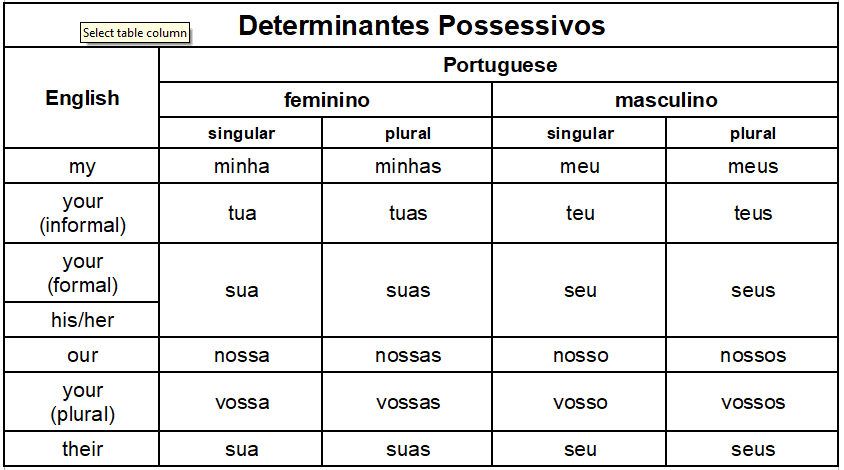
If you look, you’ll notice that the words for your/yours/ his/his/ her/hers are the same. You may be thinking that that can be vague. You’re right and there is a way to make things a little more clearer. That is covered under dele and dela below.
How to use in conversation
As mentioned earlier, possessive determiners are used with the noun and the possessive pronouns replace the noun they’re referring to. They often occur together in conversation.
Examples
O meu carro é novo. O seu é velho. (My car is new. Yours is old.)
In the first sentence “meu” accompanies and describes the object “carro”, therefore it’s a determiner. In the second sentence notice that “seu” is masculine, replaces the word “carro” and therefore is a pronoun.
🇬🇧English: My mother is called Rita. What is yours called? (my = determiner / mother = noun / yours = pronoun)
🇵🇹Portuguese: A minha mãe chama-se Rita. Como se chama a sua? (minha = determinante / mãe = nome / sua = pronome)
More examples of using the possessives in Portuguese regarding people, such as referring to family members in Portuguese.
O meu pai – my father
A minha mãe – my mother
O teu tio – your uncle (informal)
A tua tia – your aunt (informal)
O vosso neto – your grandson (when speaking to more than one person)
A vossa neta – your grandaughter (when speaking to more than one person)
O seu irmão – you brother (formal)
A sua irmã – your sister (formal)
O nosso avô – our grandfather
A nossa avó – our grandmother
dele and dela
This is the other group of possessives I mentioned in the intro. Grammatically, they aren’t pronouns or determiners but prepositional groups/phrases. This is because they use a preposition in their construction. In the case of possessives, it’s the preposition “de” (of/from).
And remember when I mentioned that using sua/seu/suas/seus for you, he, she and it can get vague? Well, by using these prepositional groups you’ll eliminate a lot of the vagueness.

These are different from the previous ones because they vary according to the gender and number of the possessors. This means that there is only one form for each grammatical person:
When I say “his friend” we say “the friend of him” = o amigo dele.
her friend = “the friend of her” = o amigo dela.
their (males) friend = “the friend of them” = o amigo deles.
their (females) friend = “the friend of them” = o amigo delas.
Note that in every example, the noun (amigo) remained the same and it was the possessive that changed to indicate who is “possessing”.
Practice with this Free Quiz

Related Posts for further reading:
- Learn Portuguese Pronouns with confidence
- Object Personal Pronouns in Portuguese
- Prepositional Pronouns in Portuguese
- Personal Pronouns in Portuguese
- Subject Personal Pronouns in Portuguese
Would you like to practise more Portuguese on a daily basis? Try out my 30-Day free challenge where I send you an activity per day to complete (for 30 days). More info here.
Did you enjoy this lesson? Consider joining my patreon page for exclusive content and Portuguese lessons. Don’t want to have a monthly subscription? Buy me a coffee instead for my hard work! Don’t forget to join my mailing list or try out the 30 day challenge below.