

Who are the popular saints of Portugal? And why are they all celebrated in June? These celebrations are also known as Festas Juninas and are generally held around the summer solstice in June in the northern hemisphere. You may know them as Midsummer celebrations. The difference is, that Portugal dedicates three days to this instead of one.
These three days correspond to different municipal holidays. For instance, Lisbon celebrates Santo António, Porto and Tavira celebrate São João and Évora and Sintra São Pedro. See a full list of municipalities below.
Historical and Religious Background
The origins of Os Santos Populares in Portugal date back to ancient pagan and pre-Christian traditions. These were later assimilated into these Christian festivities. The celebrations were initially associated with the summer solstice and agricultural rituals, celebrating the abundance of crops and the arrival of summer. Over time, the pagan celebrations merge with Christian religious beliefs, incorporating the veneration of the three popular saints.
It is worth noting that many customs associated with the Santos Populares are cultural traditions that developed over centuries alongside Portugal’s Catholic heritage. In Catholic teaching, the saints are honoured as examples of faith and are not worshipped. While Santo António, São João and São Pedro are associated with particular cities, professions, and traditions, many popular beliefs and customs surrounding them form part of Portugal’s rich folklore and local culture.
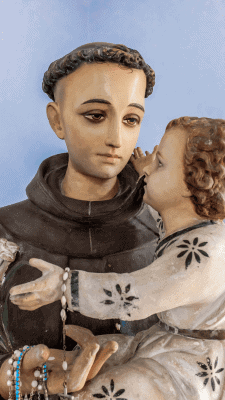


Santo António, São João, and São Pedro hold significant religious importance in Portugal. Sto António is particularly revered as the patron saint of Lisbon (although the main patron Saint of the Capital is Saint Vincent).
- Santo António (Saint Anthony) is widely known for his reputation as a matchmaker.
- São João (St John the Baptist) is celebrated as the patron saint of Porto. Many traditional customs associated with his feast day have historically been linked to themes of good fortune, fertility, and abundance.
- While São Pedro (Saint Peter) is the patron saint of fishermen and is honoured in coastal communities.
The Junine celebrations are also often associated with couples and love: Saint Antony for the singles and betrothed, St John for the married and Saint Peter for the widowed.
Main Traditions of The Popular Saints of Portugal
The Santos Populares festivities in Portugal are lively street parties (arraiais), marching parades (marchas populares) and traditional food. People dress up in colourful costumes, and the streets are adorned with decorations such as colourful banners, streamers, paper balloons and paper flowers. The air is filled with the scent of grilled sardines, a popular delicacy during these celebrations.


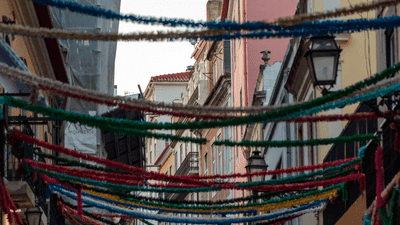


Although there is a lot of overlap, each Saint has one distinctive tradition. For Santo António, it’s the exchange of manjericos with paper carnations and quatrains.
One of the most distinctive São João traditions is the “martelinhos” (little hammers). These are small plastic hammers that people use to gently bonk each other on the head, as a playful gesture symbolising luck and good fortune.
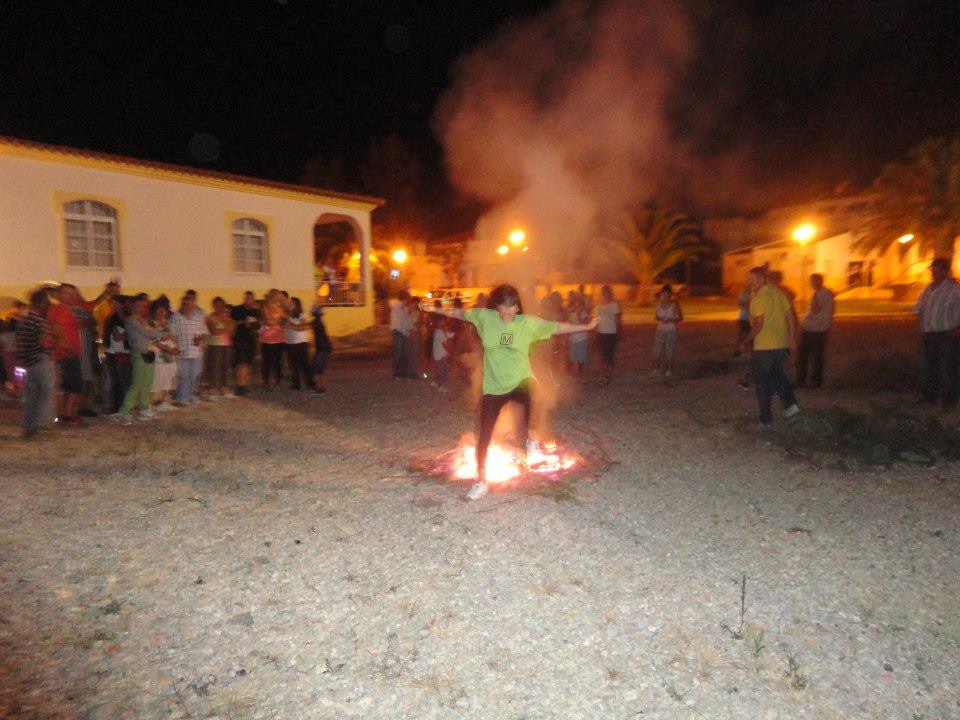
And for São Pedro, it’s leaping over the fire. Coming from an old pagan tradition and later incorporated into the popular saint’s traditions, one jumps over the fire for good fortune, love and luck.


Another important aspect of the Santos Populares is the street dances, like the “Bailarico“. Accompanying are the sounds of traditional Portuguese instruments such as the accordion and the concertina.
Food:
The main staples for these celebrations are invariable and always include grilled sardines, caldo verde, broa de milho, bifanas and vinho tinto.
Best Places to See the Celebrations
So where can you see the celebrations? As I’ve mentioned, we celebrate the Santos Populares throughout Portugal, but certain cities are particularly famous for their vibrant and exuberant celebrations. The most famous and lively celebrations occur in Lisbon, Porto, and Braga.
Lisboa
In Lisbon, the Alfama neighbourhood hosts one of the largest and most traditional Santo António celebrations. The narrow streets come alive with music, dancing, and the smell of grilled sardines. The highlight is the Santo António parade, where colourful floats, local associations, and traditional costumes take centre stage.
Porto
In Porto, the Festa de São João on the night of June 23rd is an extraordinary event. The entire city transforms into a vibrant celebration, with fireworks, music, street parties, and the famous hammer bonking tradition. People gather along the Douro River to enjoy the festive atmosphere and witness the spectacular fireworks display.
Tavira
Of course, because I’m from Tavira, I have to mention it in this list too as a good place to celebrate São João. The city comes alive with vibrant street parties, music, dancing, and spectacular musical and fireworks displays, creating a festive atmosphere that locals and visitors alike can enjoy.
One of the distinctive features of São João in Tavira is the reenactment of the legend of the Moorish princess by our castle.
Braga
Due to its numerous churches, Braga, the “Rome of Portugal” is also famous for its Santos Populares celebrations. If there is one characteristic that distinguishes Braga’s St John’s festivities from the rest of Portugal, it is its history, so ancient, grandiose and memorable, made by the people of its community! The city hosts a grand procession honouring São João, attracting thousands of visitors. The streets adorn arches made of flowers and lights, creating a magical ambience.
Afurada
This is one of the biggest festivals in the Vila do Conde municipality. During the São Pedro da Afurada celebrations, the village comes alive with a variety of activities and traditions. The main focus is on the sea and the fishing culture. The highlight of the festivities is the procession of the fishermen’s boats, beautifully decorated and parading along the Douro River.
Frequently Asked Questions
In conclusion
If you’re visiting or already live here, it’s worth visiting your local municipal’s web page or the local tourist office to find out what’s happening in your area. Below is a full list of which municipalities celebrate which Popular Saint.
Municipal Popular Saint Holidays
Below is a full list of all the municipalities in Portugal that celebrate the Popular Saints.
Santo António (13th June):
Aljustrel (Beja), Alvaiázere (Leiria), Amares (Braga), Cascais (Lisboa), Estarreja (Aveiro), Ferreira do Zêzere (Santarém), Lisboa (Lisboa) Proença-a-Nova (Castelo Branco), Reguengos de Monsaraz (Évora), Vale de Cambra (Aveiro), Vila Nova da Barquinha (Santarém), Vila Nova de Famalicão (Braga), Vila Real (Vila Real), Vila Verde (Braga).
São João (24th June):
Alcácer do Sal (Setúbal), Alcochete (Setúbal), Almada (Setúbal), Almodôvar (Beja), Angra do Heroísmo (Açores), Armamar (Viseu), Arronches (Portalegre), Braga (Braga), Calheta (Madeira) (Madeira), Castelo de Paiva (Aveiro), Castro Marim (Faro), Cinfães (Viseu), Figueira da Foz (Coimbra), Figueiró dos Vinhos (Leiria), Horta (Açores), Lourinhã (Lisboa), Lousã (Coimbra), Mértola (Beja), Moimenta da Beira (Viseu), Moura (Beja), Nelas (Viseu), Porto (Porto), Santa Cruz das Flores (Açores), São João da Pesqueira (Viseu), Tabuaço (Viseu), Tavira (Faro), Valongo (Porto), Vila do Conde (Porto), Vila do Porto (Açores), Vila Franca do Campo (Açores), Vila Nova de Gaia (Porto).
São Pedro (29th June):
Alfândega da Fé (Bragança), Bombarral (Leiria), Castro Daire (Viseu), Castro Verde (Beja), Évora (Évora), Felgueiras (Porto), Macedo de Cavaleiros (Bragança), Montijo (Setúbal), Penedono (Viseu), Porto de Mós (Leiria), Póvoa de Varzim (Porto), Ribeira Brava (Madeira), Ribeira Grande (Açores), São Pedro do Sul (Viseu), Seixal (Setúbal), Sintra (Lisboa).
Related Posts for further reading:
- Celebrating Saint Anthony in Portugal
- Os Tronos de Santo António
- As Noivas de Santo António
- Manjerico de Santo António
- São João in Portugal
- Cascatas de São João
- Balões de São João
- Leeks and Hammers for São João
- São Pedro in Portugal
- Rusgas de São Pedro
June in Portugal | Portuguese Culture | The Portuguese Learning Hub