
In this post you’ll find out what the different sounds of the letter “s” in European Portuguese are. The sound of the “s” changes, depending on where it is in the words. So lets look at how it changes.
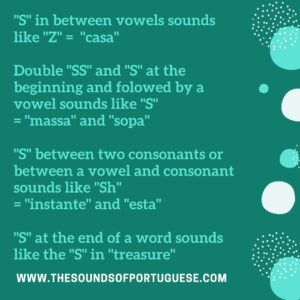
“S” will sound like:
- Z – when it is in between two vowels. Examples: “casa”, “mesa”, “peso”, “tesouro”.
- SH – when it’s in between a vowel and a consonant or between two consonants. Examples: “pasta”, “instante”, “teste”, “este”.
- S – when it’s at the beginning of a word and followed by a vowel and when it’s doubbled (ss). Examples: “massa”, “passar”, “sol”, “sapato”.
- The last sound is the most difficult one and it’s a voiced “sh”. This is the same sound as the “s” in words like “treasure” and “measure”. And the position of this “s” is always at the end of the word. Examples: “carros”, “lápis”, “bolas”, “patos”.
An added challenge is that in some cases a final “s” may change to a “z” sound if the next word begins with a vowel. For example:
“mas é” – the “s” will run into the next word and will change to a “z” sound when we link the words: “mazé”.
“Mesas azuis” – the second “s” in mesas will sound like a “z” and link onto the “a” from azuis: “mesazazuis” (this will never be written this way).
Do you need to make these links? No, but it’s what will give your speaking fluidity and ultimately is the one of the key secrets to sounding becoming fluent.
Be sure to ask me about other pronunciation issues you may be experiencing.
Watch the video of the sounds of “s” in European Portuguese below.