
In this post, we’re learning how to write a formal email in European Portuguese. When speaking the language, there are always two main things to take into account:
- the level of formality between the participants
- whether the person is female or male
It’s even more so the case when writing in Portuguese. Keep in mind that many times the meaning doesn’t translate very well across languages. What sounds great or appropriate in your language may just sound awkward or wrong.
Formality Levels
Regarding formality levels, there are three of them to consider: informal, semi-formal and formal.
- Informal This is the speech to use with people who are close to you, such as your friends, your other half or family members.
- Semi-formal This is the speech to use with co-workers or someone older than you that you are acquainted with on some level.
- Formal This is the speech used with strangers; work and business emails; and official correspondence.
Formal Letters or Emails
In this post, we’re looking at the formal level. This applies only in writing to someone you want to contact for the first time; someone in a high/higher position in your company or another institution. (informal and semi-formal)
Beginning:
We use the term “excelentíssimo” or “excelentíssima” in their abbreviated forms. They translate roughly to “very excellent you”.
- for males: Ex.mo Sr. + degree (if you know it) + first and last name
- for females: Ex.ma Sra. + degree (if you know it) + first and last name
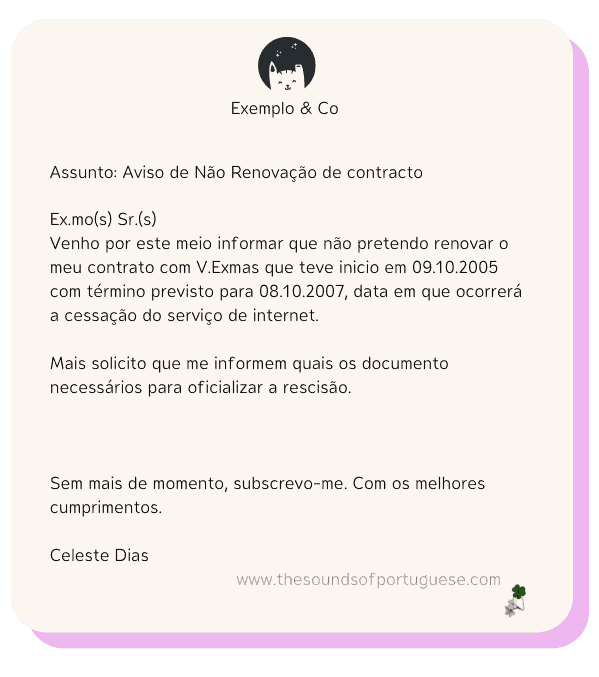
If you don’t know whom you are writing to a big organization and are not sure who will be reading your email you can start with the following: Ex.mo/a (s) Sr./Sra.(s)
Which is like an all-in-one greeting to anyone who may read it.
The body of the email:
The body of these kinds of emails has specific wording, not used in everyday conversation. These include sentences like:
“venho por este meio solicitar informações acerca do curso.” (Literally: I come through this means to request informations about the course)
“somos a informar que haverá corte de água na Rua Branca às 15h00.” (Literally: We are to inform that there will be a water cut on Branca St. At 3pm)
When ever you need to use “you” in a formal email, please use V.Exa (singular) or V.Exas (plural). These translate into “your excellency” or “your excellencies”. This too is not used in normal conversation.
End the email or letter:
- “Estou ao Seu/Vosso inteiro dispor para qualquer esclarecimento adicional” (I’m at your intire disposal for any additional clarification)
- “Com os melhores cumprimentos.” (with the best regards /compliments / greetings)
- “Sem mais de momento, subscrevo-me. Com os melhores cumprimentos.” (with nothing more at the moment, I subscribe myself (I sign). with the best regards /compliments / greetings)
- “aguardo a Vossa resposta/proposta/etc” (I await your answer/proposal/etc)
- “espero ansionsamente pela Vossa resposta/proposta/etc” (I wait anxiously for your response/proposal/etc).
Then add your first and last name. If it’s a personal email you can opt to include your phone number. But if it’s a professional email, under your name add the company you work for/ your position / and your phone number or other contact.
Example
Here is an example of a formal email:
If you’d like to learn how to pronounce some of these sentences please the video below.