

October 5th is a national holiday because, in 1910, Portugal ceased to be a monarchy and became a republic.
This revolution on October 5th was the result of a long process of political, social and mental transformation. It led to the erosion of the Portuguese monarchy and the strengthening of the Portuguese Republican Party. But before continuing, we have to go back a little further in time, to better understand what foreshadowed these developments.
The Berlin Conference and The Pink Map
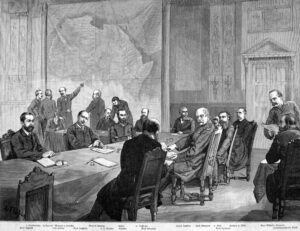
At the end of the 19th century, the world was going through a period of technological development. Thus, the demand for raw materials increased considerably. Around the same time, several countries were disputing territories in Africa, including Portugal.
Between 1884 and 1885, the Berlin Conference took place. The Portuguese government presented its plan to exercise sovereignty over the territories between its colonies Angola and Mozambique. (Today are Zimbabwe and large parts of Zambia and Malawi). Portugal then presented a map in 1886.
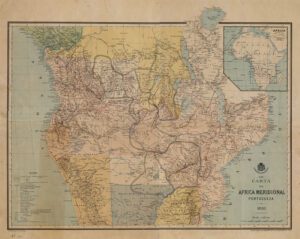
This map is the famous Pink Map, and it was named so because of the pink tones that represented this expansion.
But the Portuguese plan clashed directly with English interests. To connect Cairo in Egypt to Cape Town in South Africa via a railroad (Cape to Cairo Railway).
Therefore, this resulted in a dispute between Portugal and England. Which later culminated on January 11th, 1890, when Lord Salisbury’s British government sent the Portuguese government an ultimatum.
This ultimatum demanded the immediate withdrawal of Portuguese forces from the territories in question. Moreover, England would declare war on Portugal if they didn’t.
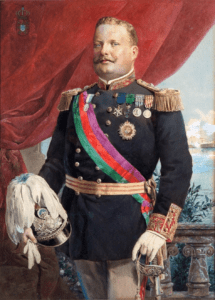
Consequently, the Portuguese King at the time, D.Carlos I, promptly gave in to British demands. This was seen as a huge national humiliation by large parts of the Portuguese population and elites as well. Taking advantage of the wave of discontent of the people, the Republican Party called this an act of self-treason.
The Revolt of January 31st 1891
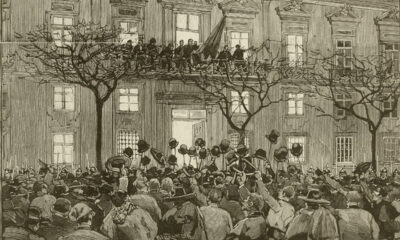
The royal family was already disliked due to its excessive self-serving spending. Plus an apparent inability to keep the country up with technological developments like the rest of the world. After this attitude, considered cowardly by many, it fell even lower in people’s esteem. This situation worsened with the financial crisis that arose between 1890 and 1891. This crisis was due to a drop in emigrants’ remittances from Brazil. Which, in turn, was also undergoing a financial crisis following the establishment of its republic just two months earlier.
The first revolt against the monarchy took place in the city of Porto on January 31st, 1891. The rebels sang a song called “A Portuguesa” composed by Alfredo Keil and written by Henrique Lopes de Mendonça.
This revolt had the support of some military personnel. But, failed due to the barring by a strong detachment of the Municipal Guard, still loyal to the monarchy.
Unfortunately, many people lost their lives in this coup d’état. The song became recognized as a symbol of this revolt. But this still isn’t when Portugal ceased to be a Monarchy.
Instability and the Dictatorship of João Franco

After all these events, a climate of great political, social and economic instability settled in Portugal. Allied to the serious difficulties and living conditions that the middle and working classes were experiencing. Thus, a great wave of revolt against the monarchy. And with it, revolutionary ideas emerged to change the regime in Portugal. A wave that the monarchist parties tried to stop.
A dictatorship, imposed by João Franco in 1907, didn’t work either.
Even in the language itself, there were proposals to revolutionize the writing of Portuguese. This later culminated in the first orthographic agreement in 1911 – a profound reform of written Portuguese.
Regicide and the October 5th revolution
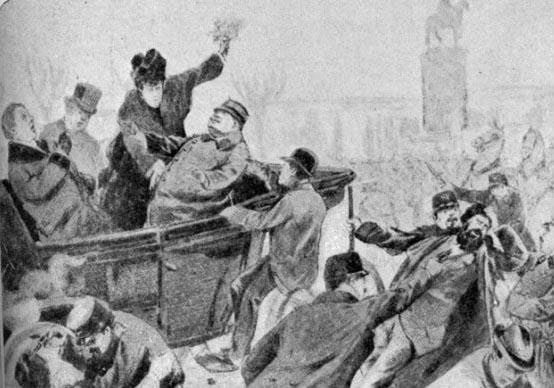
Finally, the Republicans had a great victory, when on February 1st, in 1908, the regicide took place. It happened in the Terreiro do Paço, today known as Praça do Comércio in Lison. When King D. Carlos I and his son, heir apparent D. Luis Filipe were assassinated as they passed in an open carriage through the square.
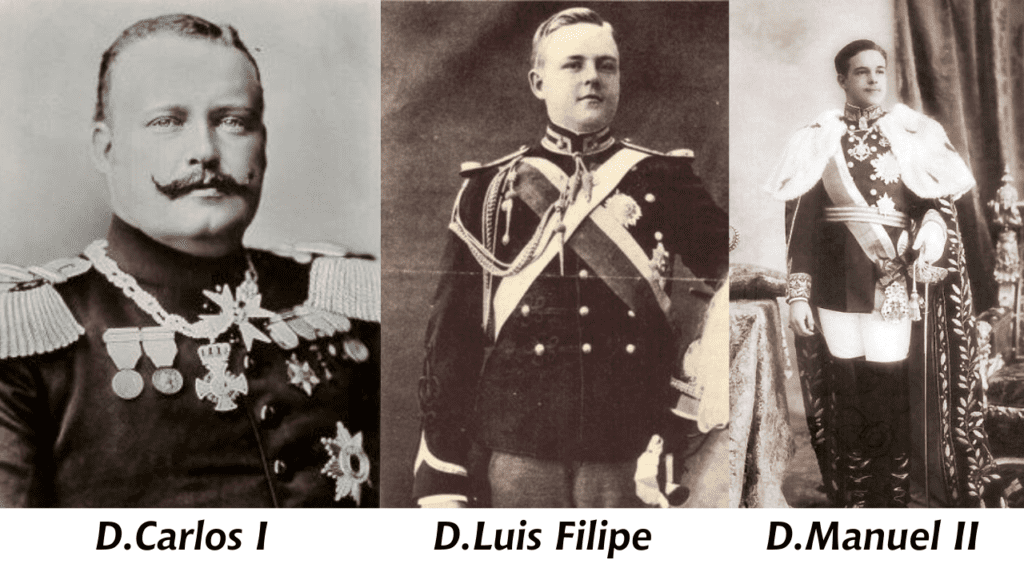
Consequently, this event profoundly marked the history of Portugal. And with it ascended the King’s youngest son, Manuel II. At only 18 years old, was unprepared to rule the country in such a politically volatile climate. He was unable to restore order in the country and contain the fury of the republicans against the monarchy.
When Portugal Ceased to be a Monarchy
Thus, in October 1910 a republican revolution began, which started on October 2nd and was declared victorious on October 5th. It was from the balcony of the Lisbon Council Steps that the republic was declared. And a provisional government, headed by Teófilo Braga, was implemented.

Exile
The royal family left the fishermen’s beach at Ericeira for exile aboard the yacht “Amélia”. First, they went to Gibraltar and then to England on the “Victoria and Albert”, sent by King George V.
Main Changes with the Country’s New Regime
Following the revolution, it was necessary to draw up a constitution that established the foundations of the new Portuguese regime.
Several rules changed, including:
- Right to strike
- Limitation of working hours to 48 hours
- Sickness and old age protection
- Compulsory schooling between the ages of 7 and 10
- Foundation of the Universities of Lisbon and Porto
- Separation of Church and State;
- Expulsion of religious orders;
- Prohibition of religious teaching in schools;
- Compulsory civil registration;
- Legalization of divorce;
Besides these measures, three national symbols were replaced: the flag, the anthem and the currency. Remember the song I mentioned that the insurgents sang during the first coup d’état? That same song became the National Anthem of the Portuguese Republic.
More info on the anthem is here.
Now that you know what happened, watching the video below will be easier to follow. English, Portuguese and Dutch subtitles are available.