

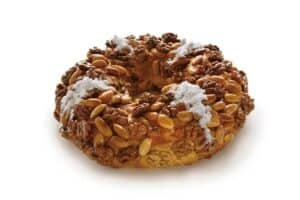
Bolo-rei is a festive cake that is part of the Portuguese Christmas and Epiphany tradition. Its name alludes to the three wise men and translates as King’s Cake. It’s a brioche-like cake, not too sweet, round in shape with a large hole in the centre, resembling a crown. The dough contains a mixture of raisins, nuts, and crystallised fruit. Click here for the recipe.

Charms and fava beans
Traditionally, hidden in the dough were a dried fava bean (broad bean) and a small metal charm. The purpose of this was to determine good or bad luck for the upcoming year. The one who finds the charm will enjoy “good luck” next year, and the one who finds the bean will have to pay for the next king cake.
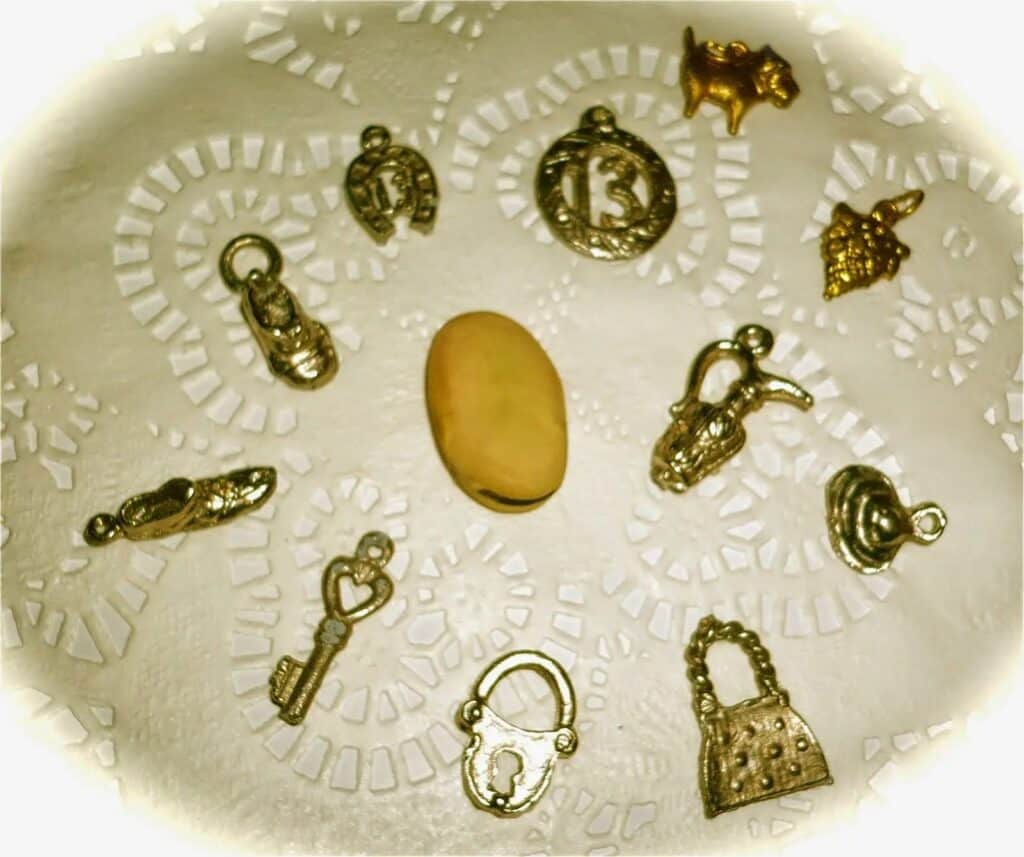
As a result, this is viewed as “bad luck”. It’s also the likely origin of some negative expressions revolving around fava beans. in Portuguese (see below). Some people would also hide small riddles in the cakes, whose reward would be half a gold pound. Others would put the actual coins in the dough as a way to give thanks. Nowadays, due to choking concerns, the Economic Food and Health Authority (ASAE) banned this practice.
Bolo-Rainha
Another cake that has become part of the Portuguese Bolo-Rei Christmas tradition is the Bolo-Rainha (“queen cake”). This version tends to be a bit more expensive. The reason for that is that it has more nuts in it, such as almonds, pine nuts, walnuts and cashews. It’s a blessing for those who don’t like crystallised fruit that much.
Origin of the Bolo-Rei tradition
It’s said that the origin of Bolo-Rei goes back to the Roman Saturnalia celebration. Specifically, a cake made of figs, dates, and honey with a fava bean hidden inside. After that, the Catholic church converted this Roman tradition to be symbolic of the Epiphany celebration.
Inspired by the French
Interestingly, the 19th-century French gateau des rois is the inspiration for the current Portuguese Bolo-Rei. In the same vein, the French tradition included a dry fava bean and a porcelain gift in the cake. The porcelain gift was usually a figurine of the nativity scene.
The one to find the bean was considered the king or queen of the party. With this came the right to wear a circumstantial crown and could ask for a wish. In addition, they also needed to pay for the next cake. From 1870 onwards, porcelain beans replaced the dry beans. Later, cats and other “good luck” objects replaced the nativity figurines. Subsequently, plastic replaced porcelain.

Legend says that it was the Three Wise Men – Gaspar, Belchior and Baltazar – who gave rise to a version of the famous Bolo-Rei. The cake symbolises the gifts that they brought to baby Jesus: gold, myrrh and frankincense. The crust of this crown-shaped cake symbolises the gold, the crystallised fruit and dried nuts mimicking precious gems represent the myrrh, and the cake’s aroma represents the frankincense.
According to the story, after the Wise Men saw the star announcing the birth of Jesus, they disputed among themselves which of the three would have the honour of being the first to give their gift to the Child.
To settle this argument, a baker made a cake hiding a fava bean inside. The one who found it was the winner. The story does not say which one found it. Similar to the Portuguese, the Egyptians also view the fava bean as bad luck. However, they also believe the bean to be cursed – a vessel for evil spirits!
Expressions revolving around fava beans
Even nowadays, we have a few negative expressions in Portuguese revolving around fava beans. Some of these are:
“vai à fava!” – “go fava picking!” a lighter/polite way to say “F….off!” or “get lost!”. As you can imagine, fava picking is painstakingly slow work. A similar expression is: “vai pentear macacos!” – “go comb/groom monkeys!”. This one is unrelated to favas and a favourite among my students.
“calhou-me a fava!” – “The fava fell to me!” meaning “I got the short end of the stick!”
“Vai à fava enquanto a ervilha enche” – “go fava picking while the peas fill up”. This expression has a similar meaning to the first one. To clarify, favas come in first even though they are sown at the same time as peas. Either way, you’re telling someone to go away.
Let me know what you think of the story and the Portuguese Bolo-Rei Christmas tradition. I look forward to reading about your Christmas traditions!
Adelina x
Related Portuguese Traditions
- Bolo Rei Recipe
- January Traditions in Portugal
- New Year’s Eve in Portugal
- Christmas in Portugal
- Portuguese Food
Ready to Improve Your European Portuguese?
Reading about Portugal and Portuguese Tradition is great. But real progress comes from structured listening, repetition and guided practice.
Inside the Language Hub, you get:
- Audio-based lessons in European Portuguese
- Comprehension exercises
- Real-world vocabulary
- Clear explanations without overwhelming grammar
If you want to understand Portuguese beyond textbook dialogues, this is your next step.
Thanks for your labor in making this site and your YouTube channel. I how have an appreciation of why Portuguese conversations in the real world are impossible to decider as words are blended together and why this is so. I’m going back to Lisboa this year (hope the mask are gone) and see if the Snack Bar I eat at almost each day is still open. I spoke no Portuguese except one word social interactions and they spoke no English. They had a birthday and invited me to join by waving hands for me to come over. Many other things happen as well and I want to see them and speak in sentences.
Thank you so much for your kind comment! I’m so happy you like my work. That’s a great story! I hope they are open too and you can have more conversations this time. Mask wearing is still obligatory until mid September (if the official rules don’t change before that).