
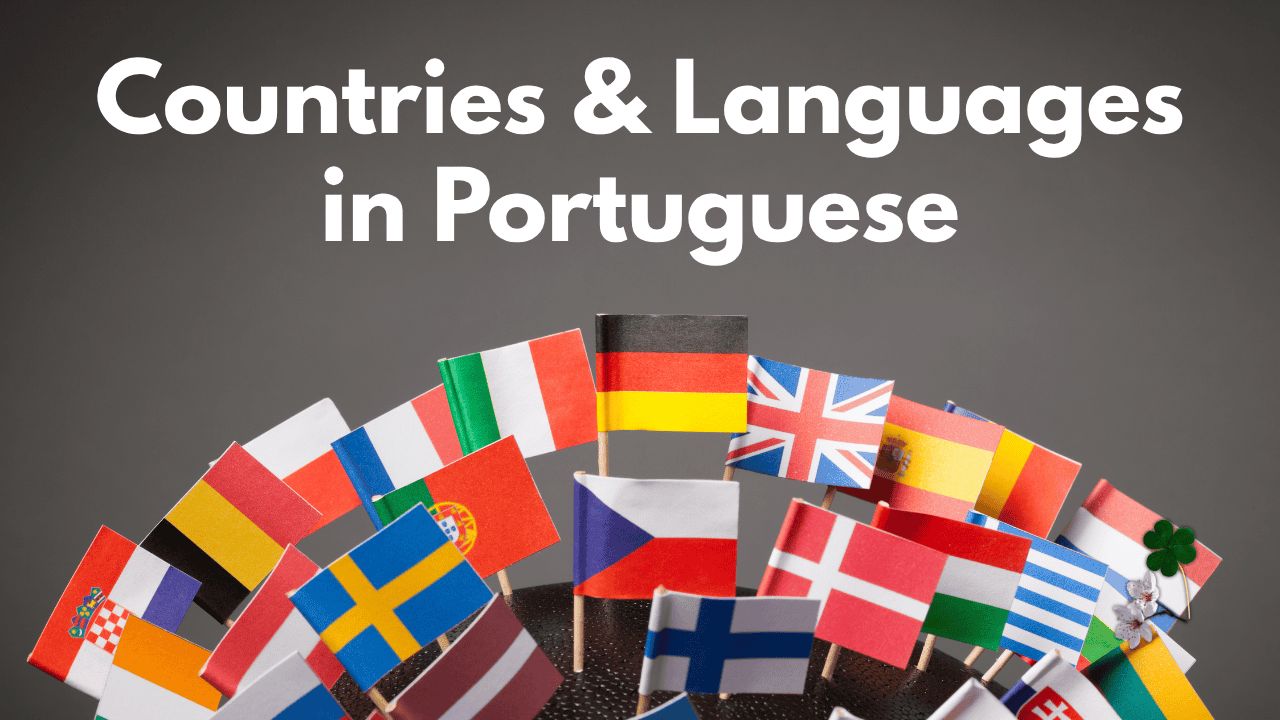
When learning European Portuguese, you’ll probably want to talk about where you’re from, where you live and which languages you speak. These are useful things to know when introducing yourself and getting to know other people.
But how do you say Irish, Dutch, American or English in Portuguese? And what’s the difference between the name of a country, a nationality and a language?
Let’s start with a little story.
Countries, nationalities and languages: a little story
Listen as many times as you need before activating the subtitles.
Sou irlandesa e portuguesa, mas nasci em Amesterdão, na Holanda. Quando era mais nova, falava holandês muito bem. Hoje, falo inglês e português.
O meu marido é dos Estados Unidos, por isso é americano. Fala inglês e está a aprender português.
A nossa filha nasceu em Portugal. É portuguesa e americana e fala inglês e português.
Como podem ver, o país onde nascemos, a nossa nacionalidade e as línguas que falamos não são necessariamente a mesma coisa!
Now let’s look at the words you can use to talk about yourself and other people.
1. Countries and nationalities in Portuguese
In Portuguese, nationality words often change depending on whether we’re talking about a man or a woman.
For example:
- Sou português. – I’m Portuguese (man)
- Sou portuguesa. – I’m Portuguese. (woman)
- Ele é irlandês. – He’s Irish.
- Ela é irlandesa. – She’s Irish.
Here are some useful countries and nationalities to get you started.
| País (Country) | Masculino | Feminino |
|---|---|---|
| Portugal | português | portuguesa |
| a Irlanda | irlandês | irlandesa |
| a Holanda | holandês | holandesa |
| os Países Baixos | neerlandês | neerlandesa |
| os Estados Unidos | americano | americana |
| a Inglaterra | inglês | inglesa |
| a Espanha | espanhol | espanhola |
| a França | francês | francesa |
| o Brasil | brasileiro | brasileira |
| a Alemanha | alemão | alemã |
| a Itália | italiano | italiana |
| o Canadá | canadiano | canadiana |
| a Austrália | australiano | australiana |
| a China | chinês | chinesa |
| o Japão | japonês | japonesa |
| a Rússia | russo | russa |
| a Grécia | grego | grega |
Notice how some words change quite a lot, while others simply change their ending.
For example, português becomes portuguesa, and inglês becomes inglesa. Other words, such as brasileiro and brasileira, follow a more predictable pattern.
You don’t need to memorise every word at once. Start with the countries and nationalities that are most relevant to you, and notice how the words change as you encounter them in context.
A little note about capital letters
In English, we write nationalities and languages with capital letters: Irish, Portuguese, English.
In Portuguese, we generally use lower-case letters:
- português
- irlandês
- inglês
- francês
This is a small difference between the two languages that’s worth noticing.
2. The names of languages in Portuguese
Now let’s look at the languages themselves.
| Português | English |
|---|---|
| português | Portuguese |
| inglês | English |
| irlandês | Irish |
| holandês | Dutch |
| neerlandês | Dutch |
| espanhol | Spanish |
| francês | French |
| italiano | Italian |
| alemão | German |
| português brasileiro | Brazilian Portuguese |
| mandarim / cantonese | Mandarin / Cantonese |
| japonês | Japanese |
| russo | Russian |
| grego | Greek |
A quick clarification: holandês and neerlandês are both used for the Dutch language. Neerlandês is the more precise name for the language, while holandês is very common in everyday conversation.
Also, although brasileiro describes a Brazilian person, the language spoken in Brazil is Portuguese. You might hear people refer to português do Brasil when distinguishing Brazilian Portuguese from European Portuguese.
Which languages do you speak?
One of the most useful questions you can learn is:
Que línguas falas? (Which languages do you speak?) (informal)
If you’re speaking to someone formally, you can ask:
Que línguas fala?
Here are some possible answers:
- Falo português e inglês. (I speak Portuguese and English.)
- Falo inglês, mas não falo francês. (I speak English, but I don’t speak French.)
- Falo um bocadinho de português. (I speak a little Portuguese.)
- Estou a aprender português. (I’m learning Portuguese.)
- Falava holandês muito bem quando era mais nova. (I spoke Dutch very well when I was younger.)
You can also say Falo três línguas if you speak three languages, or Falo várias línguas if you speak several.
3. How to say where you’re from
Let’s look at another useful question.
De onde és? (Where are you from?) (informal)
De onde é? (Where are you from?) (formal)
You can answer in different ways, depending on what you want to say.
- Sou da Escócia. (I’m from Scotland.)
- Sou da Índia. (I’m from India.)
- Sou dos Estados Unidos. (I’m from the United States.)
- Sou do Brasil. (I’m from Brazil.)
- Nasci na Holanda. (I was born in the Netherlands.)
- Vivo em Portugal. (I live in Portugal.)
Notice that the little word before the country changes in these examples: da Escócia, da Índia, dos Estados Unidos, do Brasil and da Holanda.
These are natural combinations that you’ll encounter frequently in Portuguese. Rather than trying to memorise a long list of grammar rules, learn them in complete sentences and notice how they work.
And remember: where you live and where you’re from aren’t necessarily the same thing!
For example:
Sou americana, mas vivo em Portugal.
I’m American, but I live in Portugal.
4. American or North American?
You may come across both americano/americana and norte-americano/norte-americana in Portuguese.
Both are used in Portugal when referring to someone from the United States.
For example:
- O meu marido é americano.
- O meu marido é norte-americano.
- A nossa filha é portuguesa e americana.
I tend to use norte-americano when talking about my husband, but you’ll also encounter americano in everyday conversation and in Portuguese learning materials, including CIPLE preparation materials.
There is a small distinction worth knowing: norte-americano can also refer more broadly to someone from North America, depending on the context. When you say É dos Estados Unidos, the meaning is clear.
What about official forms?
When filling in a form in Portugal, pay attention to what the field actually asks for.
A form may ask for your nacionalidade (nationality), or it may ask you to select a country. Depending on the form, you might see Estados Unidos or Estados Unidos da América. (EUA)
The wording varies, so don’t assume that the terminology used in a conversation will always be the wording you’ll find on an official form.
5. A few useful sentences to practise
Here are some sentences you can adapt to talk about yourself.
| Português | English |
|---|---|
| Sou irlandês/irlandesa. | I’m Irish. |
| Sou português/portuguesa. | I’m Portuguese. |
| Sou dos Estados Unidos. | I’m from the United States. |
| Sou americano/americana. | I’m American. |
| Nasci em Portugal. | I was born in Portugal. |
| Vivo na Irlanda. | I live in Ireland. |
| Falo inglês e português. | I speak English and Portuguese. |
| Estou a aprender português. | I’m learning Portuguese. |
| A minha língua materna é o inglês. | My mother tongue is English. |
| Falo português como segunda língua. | I speak Portuguese as a second language. |
You can combine these sentences to give someone a little more information about yourself.
For example:
Sou canadiana, mas vivo em Portugal. Falo inglês, francês e estou a aprender português.
Or:
Sou português, vivo em Inglaterra e falo português e inglês.
You don’t need complicated sentences to have a real conversation. A few familiar words and useful sentence patterns can already tell someone quite a lot about you.
6. E tu? Let’s talk about you!
Now it’s your turn. Can you introduce yourself in Portuguese?
Complete these three sentences:
1. Sou…
Your nationality or nationalities.
2. Vivo em…
The country where you live.
3. Falo…
The languages you speak.
Here’s my example:
Sou irlandesa e portuguesa. Vivo em Portugal e falo inglês e português.
You can make your introduction longer if you like. Perhaps you were born in a different country, speak another language or are learning Portuguese.
Listen to my conversation with Luke where we talk about languages.
If the above video was too difficult to follow, try this easier story lesson.
Try writing three or four sentences about yourself. You don’t have to get everything perfect on your first attempt. The important thing is to start using the words.
And if you’re learning European Portuguese, keep listening to Portuguese as often as you can. You’ll gradually become more familiar with the vocabulary and the way people use it in everyday conversations.
Boa sorte e até à próxima!
Back to Unidade 2 – De Onde és? Falar sobre a sua Origem e Localização