

You’ve already learned that de can mean of or from in Portuguese.
But have you noticed that sometimes you hear do or da instead?
Let’s keep it simple!
The Core Idea
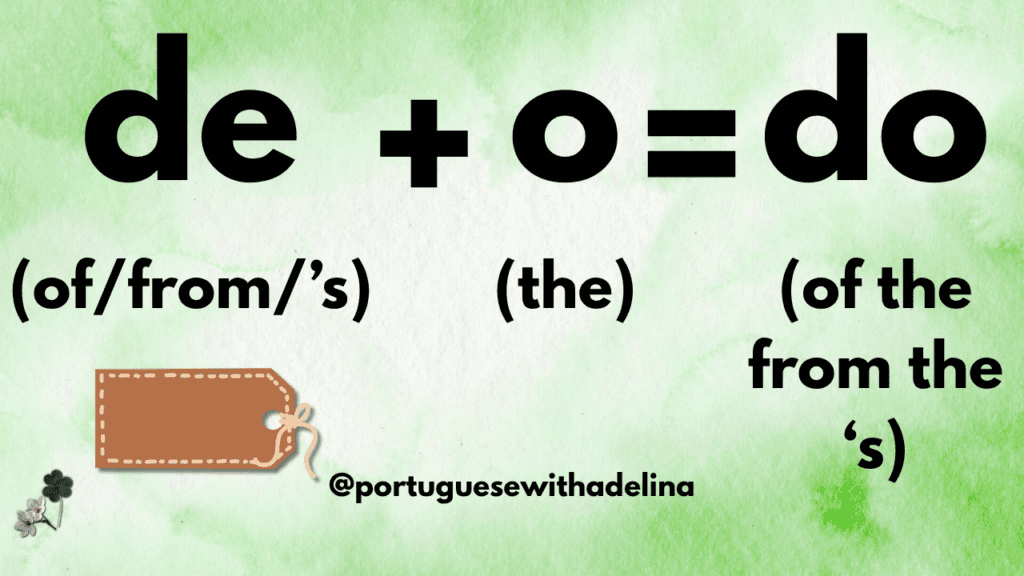
👉 DE + O = DO
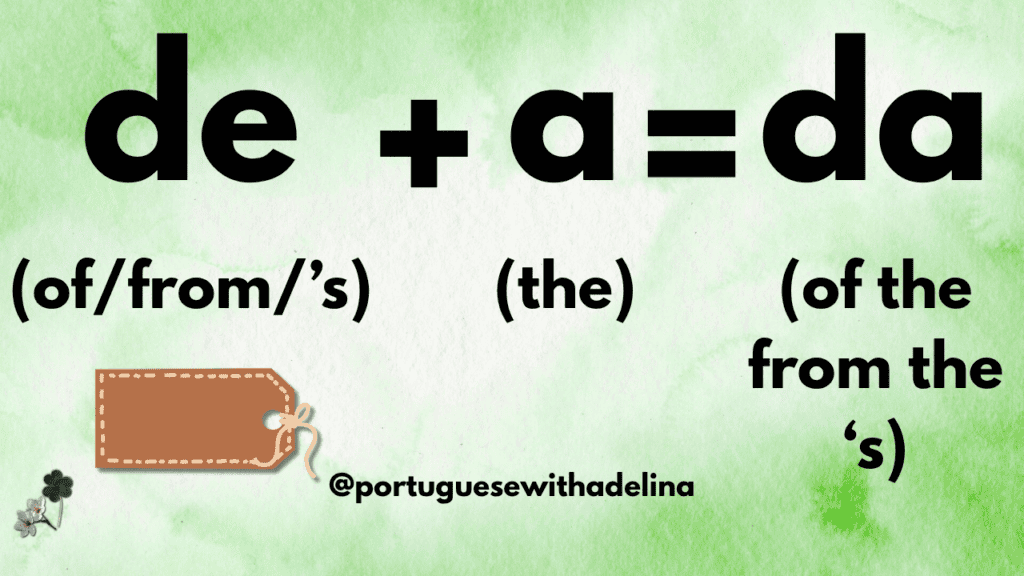
👉 DE + A = DA
In Portuguese, when de comes before the definite articles o and a, they combine to form one word.
- de + o = do
- de + a = da
We often use these forms to talk about who something belongs to or who someone is related to.
For example:
- A bola do Miguel (Miguel’s ball – the ball of Miguel)
- O computador da Cátia (Cátia’s computer – the computer of Cátia)
Notice that English often uses ‘s to show possession, whereas Portuguese can use de + the article.
Watch the Video
In this lesson, you’ll meet João, Miguel, Cátia and Afonso and practise using do and da to talk about their belongings.
Simple Examples
- O João tem a bola do Miguel.
- O Miguel tem o computador da Cátia.
- A Cátia tem os livros do Afonso.
Let’s look at what each sentence means:
- do Miguel = Miguel’s
- da Cátia = Cátia’s
- do Afonso = Afonso’s
How Do We Ask Who Something Belongs To?
In Portuguese, we can ask:
De quem é…? (Whose is it?)
For example:
- De quem é a bola? (Whose ball is it?)
- A bola é do Miguel. (It’s Miguel’s ball.)
- De quem é o computador? (Whose computer is it?)
- O computador é da Cátia. (It’s Cátia’s computer.)
- De quem são os livros? (Whose books are they?)
- Os livros são do Afonso. (They’re Afonso’s books.)
Notice that we use é for one thing and são for more than one.
Common Beginner Mistakes
A common mistake is forgetting to combine de with the article.
❌ A bola de o Miguel.
✅ A bola do Miguel.
❌ O computador de a Cátia.
✅ O computador da Cátia.
Remember:
👉 de + o = do
👉 de + a = da
Don’t forget that the form depends on the article used with the person’s name, not on whether the person is male or female.
Think About It
Look around you and choose an object.
Ask yourself:
De quem é…?
Can you answer using do or da?
For example:
- O telemóvel é do João.
- O livro é da Maria.
Write one sentence of your own using do or da.
Want to take your learning even further? 📚 Get access to the exclusive PDF with written exercises, vocabulary lists, and extra practice by purchasing it on Patreon. Or, join the Bacalhau com Natas tier to unlock interactive materials and boost your learning!
- Already a member?
- Tavira Student?
Not a member yet? Find out how
👉 PDF file (one-time purchase through Patreon)
👉 Interactive Exercises (Monthly Bacalhau com Natas membership on Patreon)
Lesson 20 | Lesson 22