
In this post, we’re learning how to write a semi-formal email in European Portuguese. When speaking, there are always two main things to take into account:
- the level of formality between the participants
- whether the person is female or male
It’s even more so the case when writing in Portuguese. Keep in mind that many times meaning doesn’t translate very well across languages. What sounds great or appropriate in your language may just sound awkward or wrong.
Formality Levels
Regarding formality levels, there are three of them to consider: informal, semi-formal and formal.
- Informal This is the speech to use with people who are close to you, such as your friends, your other half or family members.
- Semi-formal This is the speech to use with co-workers or someone older than you that you are acquainted with on some level.
- Formal This is the speech used with strangers; work and business emails; and official correspondence.
Formality Levels
This time we’re looking at how to write a semi-formal email in European Portuguese. At this level, a lot more thought is put into how you speak/write and a little more strict in how you open and close. (informal and formal)
These are emails written to people you don’t know very well. Make sure to use the right form of address or personal titles. To be polite and to show good manners in Portuguese, usually includes someone’s degree. But, if you don’t know it, don’t panic! you can use:
- “Sr.” = abbreviatoin of “senhor” for males
- “Sra.” = abbreviation of “senhora” for females
- “D.” (Dona) for females is also used but this tends to be more reserved for speaking and not so much in writing emails, unless you do know the person or interact with them frequently.
Semi-formal Letters or Emails
General openers include:
To males: Caro / Prezado / Estimado + Sr. + first and last name
To females: Cara / Prezada / Estimada + Sra. + first and last name
For work colleagues:
- To males: Caro colega + name
- To females: Cara colega + name
With degrees:
Some examples of degrees are: doctor, engineer, architect and they have a masculine and a feminine equivalent. So when you’re writing semi-formally you could use some of the following opening lines:
- Caro Dr. + first and surname
- Cara Dra. + first and surname
- Caro Engº. + first and surname
- Cara Engª. + first and surname
Caro Arqº. + first and surname - Cara Arqª. + first and surname
For the body of these emails you can follow the same structure as formal emails but a little less rigid. For examples lease visit that blog post here.
Signing off:
- “aguardo a Vossa resposta/proposta/etc” (I await your answer/proposal/etc)
- “espero ansionsamente pela Vossa resposta/proposta/etc” (I wait anxiously for your response/proposal/etc).
- “Cumprimentos” (greetings / regards / compliments)
- “Com os melhores cumprimentos” (with the best greetings / compliments / regards)
- “Atenciosamente” (attentively)
- “Grato / Grata” (grateful)
- “Cordialmente” (cordially)
Example
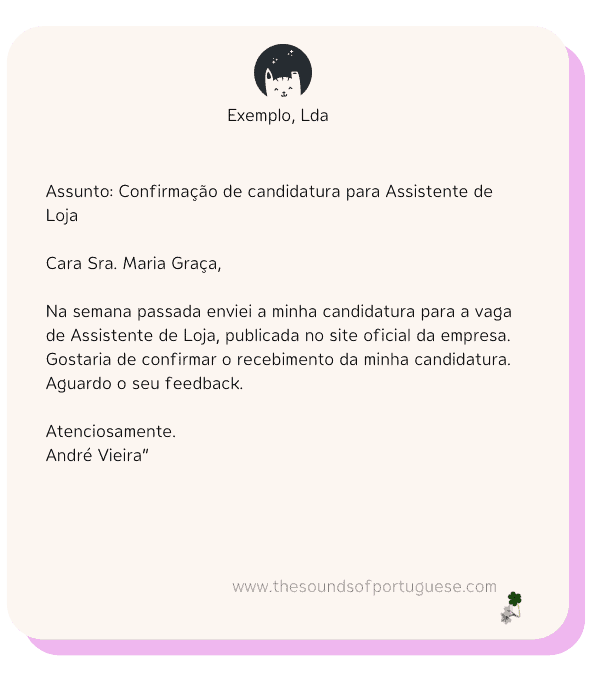
Next is an example of a Semi-formal email:
If you’d like to learn how to pronounce some of these sentences please watch the video below.