

The Manjerico de Santo António is a traditional staple of Saint Anthony festivities and also the other popular saints’ celebrations in Portugal. Come with me to find out more about this aromatic plant and find out why we buy it and who we give it to.
The Gift of Sweet Basil in Portugal
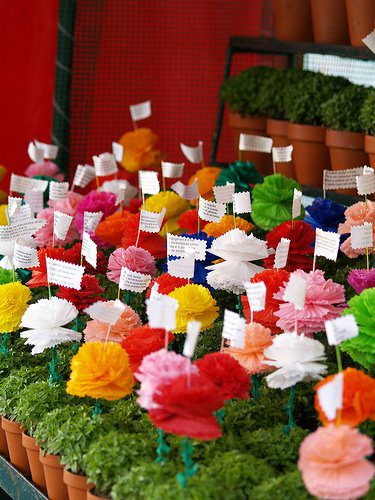
The manjerico is known as the “lovers’ herb” because, according to an old tradition, boys gave these small potted plants to their girlfriends around the time of Saint Anthony, the matchmaker saint. Once upon a time, this offering during this time of the year was seen as a proper marriage proposal. This tradition is also observed on the other popular saint days in different parts of the country, such as São João in Porto and in Tavira for instance.
The plant is always given in a terracotta pot.
Maintaining a Manjerico de Santo António
Maintaining these plants is notoriously difficult. It turns out that bush basil is a very sensitive plant and needs a lot of care. In fact, the girlfriend, upon receiving the manjerico from her “conversado” (colloquial term for namorado/boyfriend ) would take care of the plant for a year until receiving a replacement on Saint Anthony’s Day the following year.
Paper Carnations and Quartains
Besides the plant, the vase also carries a carnation made of paper and/or a small flag with a quatrain (quadra) alluding to love. A quatrain is a four-line poem with two rhymes.

Quartain on my plant this year:
Eu fui colher este cravo
Ao jardim de São João
Para oferecer à minha amada
Como prova da minha afeição
Below is the translation. Notice that in the image the “á” is a typo! This is not correct Portuguese. Also, note that the translation into English won’t rhyme.
I went to pick this carnation
At Saint John’s garden
To give to me beloved
As proof of my affection

Can you smell the manjerico?
There is a long-standing belief that one should not smell the plant directly. What one must do is stroke the plant lightly with one hand and then smell the aroma on one’s hand. Smelling the plant directly will kill it. Botanists say this is untrue. What do you think?
Click here to get back to Celebrating Saint Anthony in Portugal.