

Where’s the craic? Saint Patrick’s Day isn’t a public holiday in Portugal, and it isn’t a traditional Portuguese celebration. Most Portuguese people don’t celebrate it as part of the Portuguese cultural calendar, and many may know very little about the day. However, if you live in an area with a large international community, you may come across Saint Patrick’s Day celebrations, particularly in Irish pubs, restaurants and places where English-speaking communities gather.
In Portugal, these celebrations tend to be connected more with the Irish and wider international community than with Portuguese traditions. You might see people wearing green, listening to Irish music, dancing, enjoying Irish food and, of course, having a Guinness or a glass of Jameson. Slàinte!
Saint Patrick’s Day in Portugal
Saint Patrick’s Day is an annual celebration of Irish culture and the patron saint of Ireland, Saint Patrick (São Patrício). Although the day has its origins as a Christian feast, it has developed into a much broader celebration of Irish culture and identity. In particular, the large public celebrations associated with Saint Patrick’s Day were shaped by the Irish diaspora, especially in the United States, where the day became increasingly secular and cultural.
This means that Saint Patrick’s Day can look very different depending on where it is celebrated. For some people, it remains an important religious feast. For others, it is a celebration of Irish heritage and culture, while for many people around the world it has simply become an opportunity to enjoy Irish music, food and festivities.
Irish Connections in Lisbon
Portugal has had a long connection with the Irish community, particularly in Lisbon. One fascinating example is the Irish Dominican convent of Nossa Senhora do Bom Sucesso in Belém. The convent was founded in 1639 by the Irish Dominican Fr Dominic O’Daly and was the first continental convent founded specifically for Irish women religious. The Irish Dominican Sisters also established the Colégio do Bom Sucesso, which grew out of the convent community and continues to have a connection with the local community in Belém.
This Irish Dominican connection has also played a role in Saint Patrick’s Day celebrations in Lisbon. In March 2016, the sisters led a Saint Patrick’s Day parade involving the Colégio do Bom Sucesso. At the time, the event was described as the first Saint Patrick’s Day parade to take place in Lisbon.
So, if you remember seeing references to a Saint Patrick’s Day parade in Lisbon before 2024, you haven’t imagined it! There have been smaller community celebrations and events for many years. The distinction is that Lisbon City Council described the much larger event held in 2024 as the first Saint Patrick’s Day parade in Portugal.
Saint Patrick’s Day Parades in Portugal
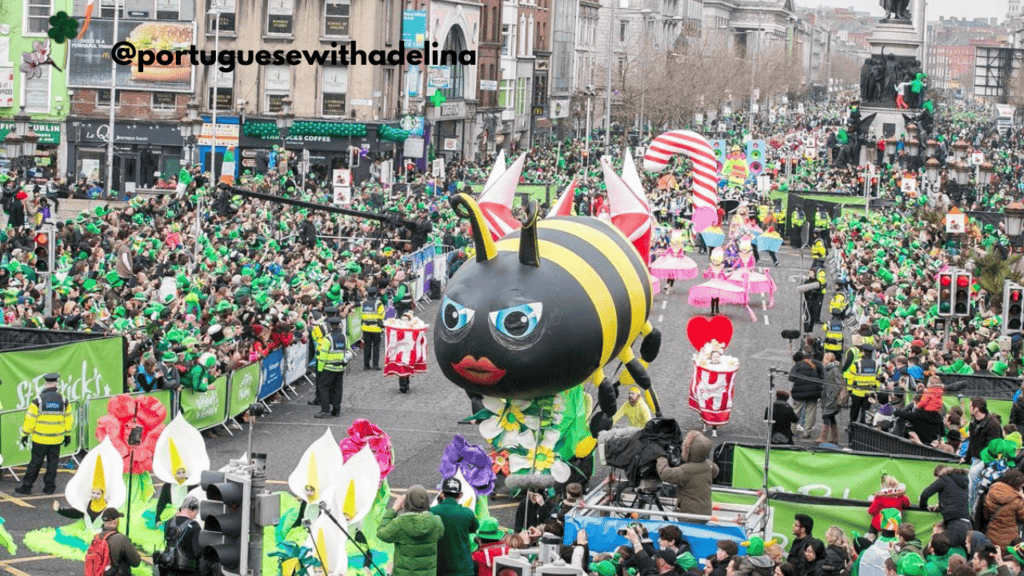
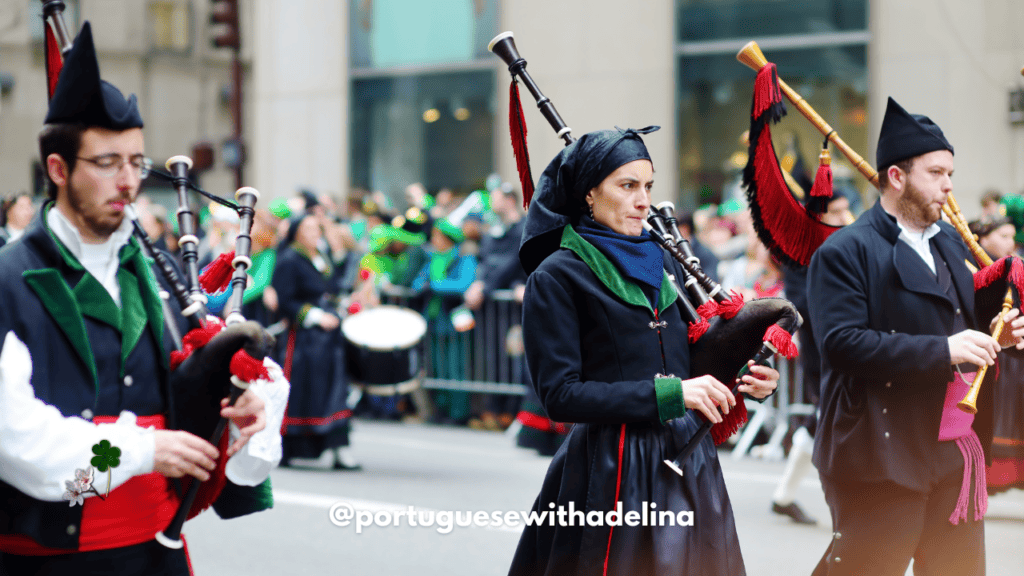
Large public Saint Patrick’s Day parades are a much more recent development in Portugal. On 17 March 2024, Lisbon hosted what the Lisbon City Council described as the first Saint Patrick’s Day parade in Portugal. More than 200 musicians took part in ten bagpipe bands, accompanied by thousands of people. The parade travelled along Avenida da Liberdade towards Terreiro do Paço, where the celebrations continued with music and entertainment.
The event grows
The event has continued to grow. In 2026, Lisbon hosted a three-day Saint Patrick’s Day programme, culminating in a parade involving around 600 musicians in 13 bagpipe bands. Nine Portuguese bands and four Spanish bands took part, bringing Irish music and culture to Avenida da Liberdade and the city centre.
These large public events are international celebrations rather than traditional Portuguese festas. They bring together Portuguese people, tourists and members of the international community, with Irish music, dancing, food and entertainment at the centre of the celebrations.

In Portugal
Although Saint Patrick’s Day is becoming more visible in Portugal, particularly in cities and areas with large international communities, it is important not to confuse this with a Portuguese tradition. Most Portuguese people do not celebrate Saint Patrick’s Day in the same way that they celebrate Portuguese festas or religious feast days.
Instead, the celebrations you encounter tend to reflect Portugal’s increasingly international communities and the global popularity of Irish culture.
Portugal has also taken part in the international Global Greening initiative, in which landmarks around the world are illuminated in green to mark Saint Patrick’s Day. This has included well-known Portuguese landmarks such as Cristo-Rei and Praça do Comércio.

As someone with Irish and Portuguese roots, I find the way Saint Patrick’s Day is celebrated in Portugal quite interesting. I’ve celebrated it in the traditional pub-style way in the past – including the obligatory Guinness and green hat! ☘️ I have also experienced the day here in a rather different way.
In 2026, Tavira hosted a special English-language Saint Patrick’s Day Mass at the Igreja de Sant’Iago. The celebration was organised by the English-speaking community and was particularly aimed at the large English-speaking community living in the Algarve.
I went along to the Mass and, somewhat amusingly, I was the only Irish person there! But seeing as I’m not fully Irish myself, I also wasn’t a faithful representation of Ireland either! But it was a lovely reminder that Saint Patrick’s Day has travelled a long way from Ireland and can take on a rather different character within international communities abroad.

Saint Patrick’s Day Vocabulary in Portuguese
People & celebrations
Music
Traditions
To celebrate Saint Patrick’s Day with you, the word of the day is o trevo (shamrock/clover).
☘️ Shamrock
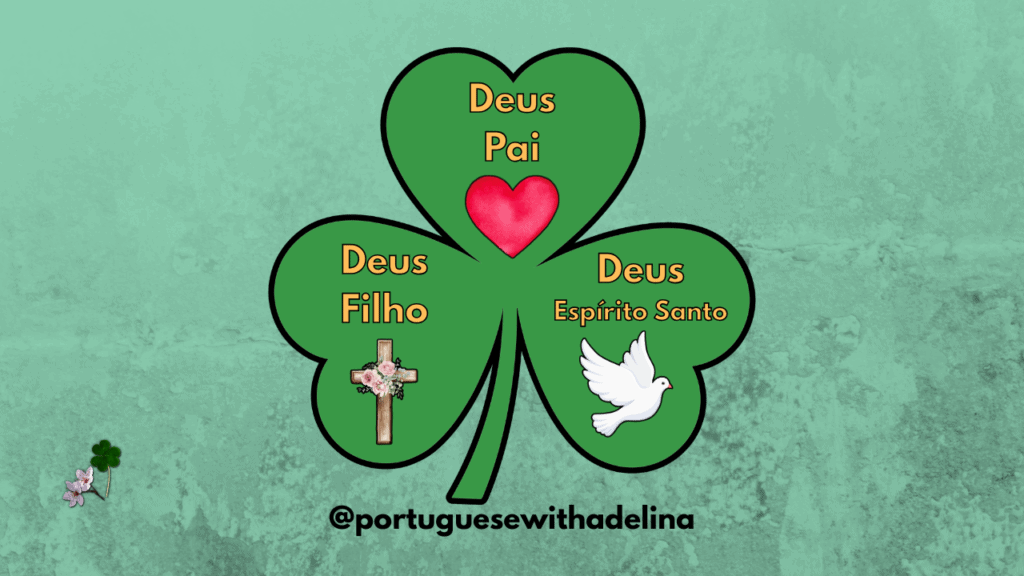
Shamrock is specifically the traditional Irish symbol: the small three-leaved plant associated with Saint Patrick and Ireland.
The interesting part is that botanically, there isn’t one officially agreed-upon species called the shamrock. Several species of clover (and sometimes related plants) have historically been claimed as the Irish shamrock.
The tradition comes from the story that Saint Patrick used the three leaves of the shamrock to explain the Christian Trinity: three persons, but one God.
🍀 Clover
Clover is the general name for plants in the Trifolium genus. There are many different species of clover, and they commonly have three leaflets, although some can have four.
So clover is the broader botanical term.
In Portuguese, though, we don’t usually make this distinction; both are generally called trevo.
Next, if you would like to practise your written Portuguese, write a sentence using the word trevo. Or write down the examples in this video and read them out loud 3 times each!
And what about Portugal? The patron saint of Portugal is Nossa Senhora da Conceição (Our Lady of the Immaculate Conception).
Related Posts & Portuguese Lessons For Further Learning
- Saint Brigid’s Day
- Pancake Day in Portugal in Carnaval
- Nossa Senhora da Conceição
- São Patrício e Portugal (Portuguese Listening Exercise)

It’s not random – there’s a simple pronunciation pattern behind it! 🇵🇹
Learning European Portuguese?
If you are learning European Portuguese, please check out my free resources and start learning today.