

Portuguese prepositions can be tricky, especially when several expressions seem to mean “above” or “over.” In this lesson, you’ll learn the difference between acima, em cima, and por cima and how to use them naturally in European Portuguese. We’ll break down each expression with clear explanations, practical examples, and common mistakes learners make.
In this grammar-focused guide, we’ll explore each prepositional expression, give clear examples, and highlight common mistakes.
For a more natural, real-life context, watch my conversation video with Luke here – a learner navigating these prepositional phrases alongside a native speaker.
1. Acima – Abstract “Above”
Use: Refers to a position above something, usually in a more abstract sense.
✅ Grammar Guide: Functions as a prepositional expression when used with de (acima de). It indicates position relative to something.
Examples:
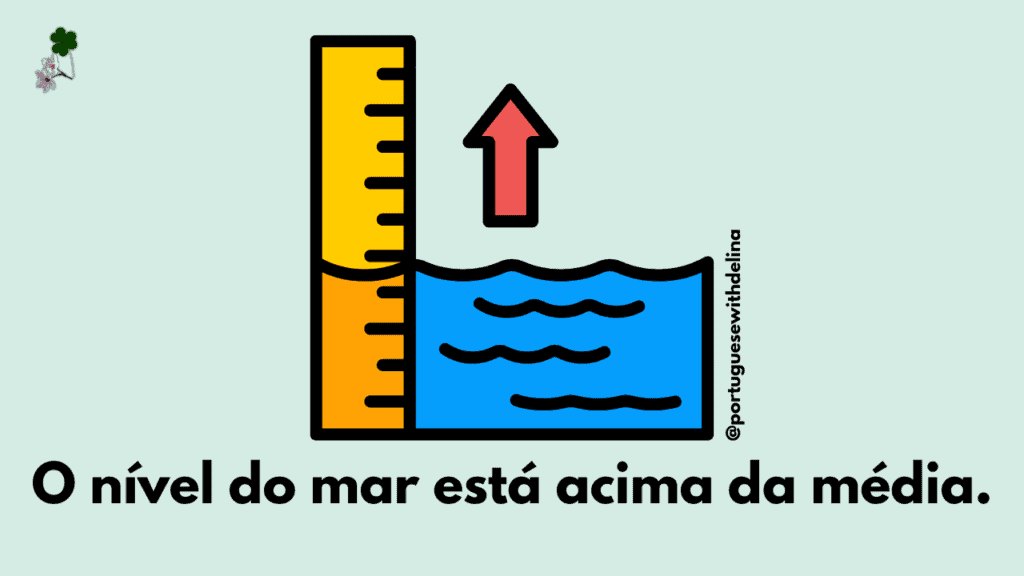
- O nível do mar está acima da média. (The sea level is above average.)
- A temperatura hoje está acima do normal. (The temperature today is above normal.)
- Os resultados da empresa estão acima das expectativas. (The company’s results are above expectations.)
Tip: Think of acima as “above” in measurements, standards, or non-physical contexts.


2. Em Cima – Literal “On Top”
Use: Refers to physical placement on top of something solid.
✅ Grammar Guide: Prepositional expression that normally functions with de (em cima de).
- O copo está em cima da mesa.
Here, em cima de works like a locative prepositional phrase meaning on top of.
Examples:
- O livro está em cima da mesa. (The book is on top of the table.)
- Põe o copo em cima do balcão. (Put the glass on top of the counter.)
- O gato dorme em cima do sofá. (The cat sleeps on top of the sofa.)
Tip: If you can touch it or place it physically, use em cima.



3. Por Cima – Motion “Over”
Use: Refers to movement over or across something.
✅ Grammar Guide: Prepositional expression of movement that functions with de (por cima de).
- Ela saltou por cima do muro. (She jumped over the wall.)
- O avião passou por cima das nuvens. (The plane flew over the clouds.)
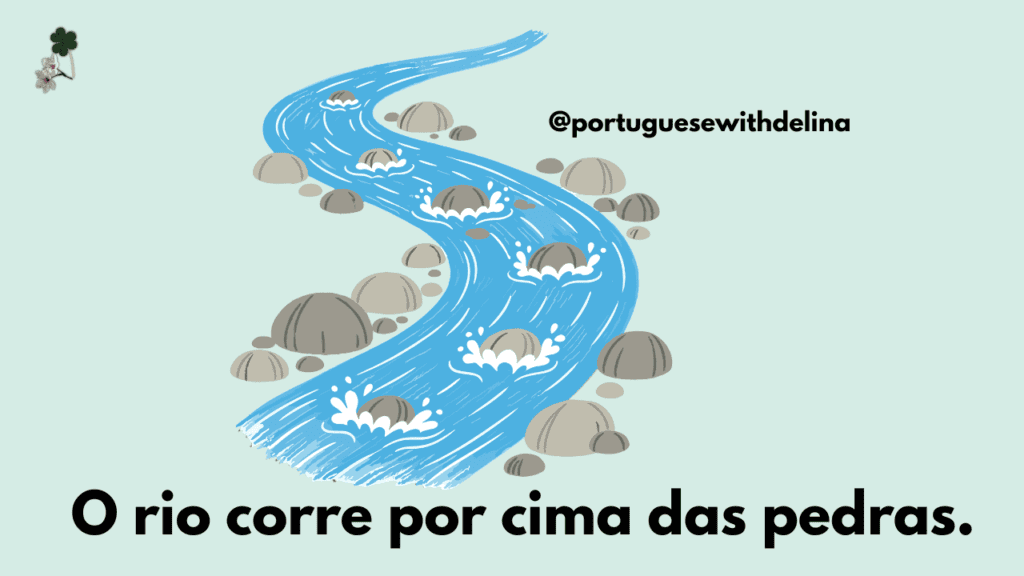
- O rio corre por cima das pedras. (The river runs over the rocks.)
Tip: If there’s motion involved, think por cima.


4. Bonus Examples & Cultural Context
Portuguese prepositional expressions appear everywhere, even in daily conversations and cultural references:
- Acima da média → can refer to ratings, scores, or abstract ideas.
- Em cima da hora → idiom meaning “at the last minute.”
- Passar por cima de algo → “to overlook” or “ignore” figuratively.
💡 These idiomatic uses will make your Portuguese sound more natural!
5. Related Lessons for further Portuguese Learning
- Watch the real conversation video here: Portuguese Conversation with Luke
- For more real-life lessons with learners, check out our Portuguese Conversations hub
- Learn the opposites of the expressions in this post (por baixo, abaixo and debaixo)
- If you want to expand your grammar knowledge, explore our Portuguese Grammar Hub
Closing
Learning prepositions in Portuguese doesn’t have to be confusing. By combining grammar rules, examples, and real conversations, you’ll understand not only how to use acima, em cima, and por cima, but also when.
Até breve,
Adelina 🌸