
Congratulations on reaching the past imperfect in Portuguese! This tense will open up many more sentences and allow you to express many more ideas and tell stories. This tense will allow you to say things like “I used to” or “When we were kids, we would…” The best way to learn this tense is to look at many examples as the conjugations are easy this time (for once). However, because of the extensive applications of this tense, I have dedicated individual posts for each of them. The links are below.
- What's the Past Imperfect?
- How is it formed?
- What about irregular verbs?
- When is the Past Imperfect in Portuguese used?
- Frequency and duration of the actions
- What used to occur (costumava)
- Simultaneous actions in the past (estava)
- Age and time in the past
- Used as a form of courtesy and to express wishes
- How should you learn the Past Imperfect in Portuguese?
What’s the Past Imperfect?
The Past Imperfect is called the Pretérito Imperfeito do Indicativo and it’s used when we refer to actions in the past that were either repetitious or ongoing. In other words, things that used to occur or would always occur.
How is it formed?
For once, conjugations will be easy to remember, and there are only FOUR irregular conjugations this time.
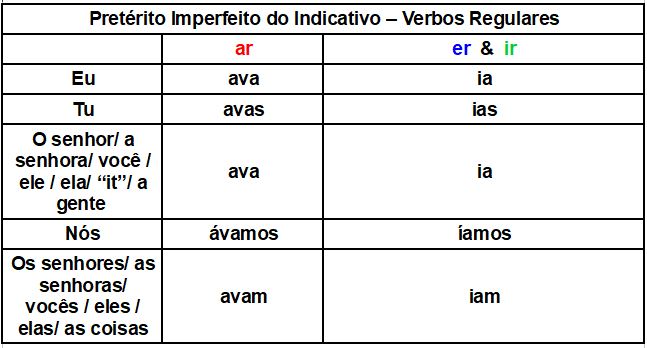
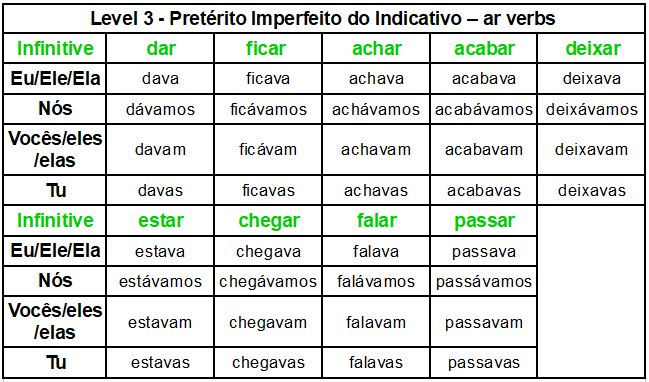
The base formula is to remove the final “r” from the infinitive and add “ava” for “ar” verbs and “ia” the “er” and “ir” verbs and then you add the normal key endings for the personal pronouns. In this tense, the “I” form and the “you/he/she/it” forms are the same. Let’s have a look:
What about irregular verbs?
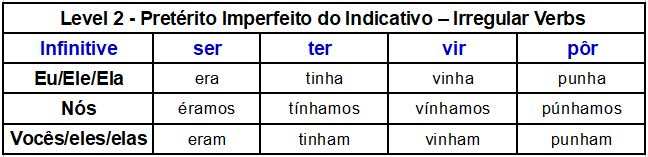
You’ll be pleased to know there are only FOUR irregular verbs this time. One of them is the verb “ser”. And the other 3 are from our familiar mini-group: the “nho” verbs.

When is the Past Imperfect in Portuguese used?
This tense is used to express past actions in several ways. We use it when referring to:
- a) Frequency and duration of the actions;
- b) What used to occur (costumava);
- c) Simultaneous actions in the past (estava);
- d) Age and time in the past;
- e) Used as a form of courtesy and to express wishes;
Let’s break that down further.
Frequency and duration of the actions
When you are referring to the frequency, this means you are talking about habitual actions in the past. “When I was young, I took the bus*” or “when I was young I would take the bus”. In Portuguese, this would be the same construction for both those:
“Quando era jovem, apanhava a camioneta.”
More examples of this use here. (coming soon)
*bus: in Portugal, if it’s an inter-city bus it’s called “camioneta” and if it’s an inner-city bus it’s called “autocarro”.
What used to occur (costumava)
This use can look the same as the frequency & duration use, however, there is a way to be more precise and emphatic when expressing “used to”. This is achieved by using the verb “costumar” in the imperfect past. “costumar” means “to have the custom of”.
“Quando eu era jovem, costumava apanhar a camioneta”
More examples of this use here. (coming soon)
Simultaneous actions in the past (estava)
This tense is the closest thing to the continuous past in English. It expresses things that were ongoing at a particular moment in time. But it’s NOT just that. There has to be another action either that happened or is happening during or whilst or when the other is ongoing. For example:
(Ontem) “Eu estava a tomar banho quando o telefone tocou.” (yesterday) “I was taking a shower last night when the phone rang”
(Quarta-feira passada às 18h00) “O bébe estava a dormir enquanto a sua mãe fazia o jantar.” (last wednesday at 6PM) “the baby was sleeping, whilst his mother cooked the dinner)
More examples are here. (soon)
Age and time in the past
Whenever referring to the time or age in the past, we ALWAYS use the imperfect past. No exceptions.
“Que horas eram quando aterraram?” (What time was it when you landed?)
“Eram 4 horas da tarde.” (It was 4PM)
“tinha 6 anos quando cortei as minhas tranças.” (I was 6 years old wehn I cut off my plaits)
More examples here. (soon)
Used as a form of courtesy and to express wishes
This is possibly the most confusing use of this tense. But it really shouldn’t be! We just use the imperfect past instead of the conditional tense. It’s similar in English. We use “would” to express things we would do way back when. We also for “what you would do if” which is the conditional tense. And we ALSO use “would” for courteous polite requests and wishes: “I would like a coffee please”/”I wish I could go there”.
“queria um café se faz favor.” (I would like a coffee please)
“gostava de ir ali” (I would like to go there)
More detailed explanation and examples here.
How should you learn the Past Imperfect in Portuguese?
By looking at lots of examples!! Follow the links in each category on this page. If you’re struggling with conjugations, then please use the method outlined below. It’s the same one we used for the present tense here.
You should already be familiar with the infinitive forms of the 25 most used verbs in conversation Portuguese (and more).
To learn these conjugations more efficiently, start with the Level 1 tables first. Take your time, it’s not a race! When you feel confident with these, “level up” your tables by adding another grammatical person row. Keep in mind, that in this tense the “I” form and the “you/he/she/it” forms are the same, so you can start with that and the “nós” form. Click here for a printout of these tables.
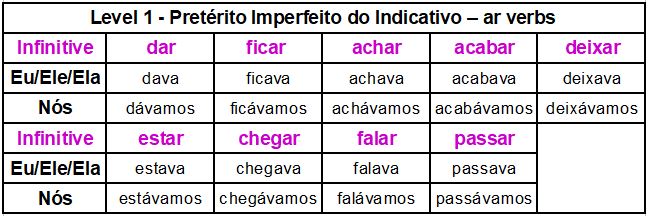


When you know these, then add the “you all and they” row (throw out the previous 3 tables).

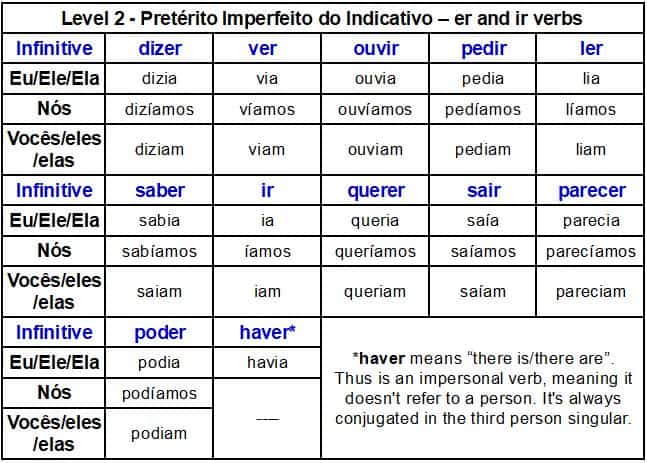
And finally, add the “tu” row if you are using this socially (and don’t forget to throw out the 3 previous tables again).

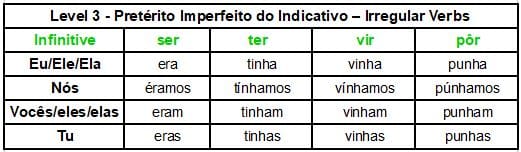
Click here for printable tables.