

To refer to a past within the past present or future we can use Pretérito Perfeito Composto do Conjuntivo. What that means is that this tense is used to express the anteriority of action in relation to another action either:
- in the past;
- that is ongoing at the moment;
- that will happen in the future;
I know that sounds complicated, but don’t worry, I’m here to walk you through this step by step (with examples). The good news is that the construction of this tense isn’t actually complex. It’s similar to its counterpart in the Indicativo mood (Pretérito mais-que-perfeito composto do indicativo). We use the verb “ter” plus the past participle. The difference is “ter” will be conjugated in the present subjunctive.
Lesson
How to Conjugate
You’ll be happy to know that you already know the conjugations for this tense. They are non-other than the verb “ter” in the present subjunctive mood conjugations plus the past participle.
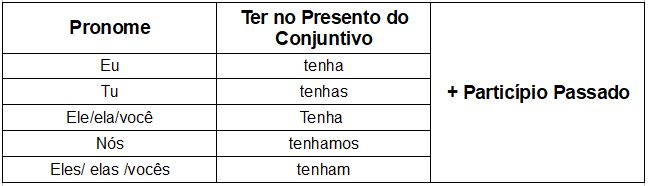
When is the past within the past present or future used?
As I said at the beginning of the post we use this tense to talk about something that happened before the other action we are we are talking about. This other action may be either in the past or is ongoing at the moment or even that will happen in the future. So let’s look at what that looks like in the language!
Remember that the conjuntivo mood is triggered by specific words and sentence structures. So, let’s have a look at what those are.
What triggers the Pretérito Perfeito Composto do Conjuntivo?
All the same triggers as the Presente do Conjuntivo will also trigger the Pretérito Perfeito Composto tense! And you know what I’m going to say next – How you know which tense to use will depend on the context.
- Impersonal Expressions (click here for examples)
- Main clauses that express a wish, desire, emotion, doubt and will
- Talvez (perhaps)
- Embora/mesmo que/se bem que/nem que/ainda que
- Antes que/até que/logo que
- A fim de que/para que
- A menos que/a não ser que/sem que/desde que/caso
- Oxalá/tomara que/quem me dera que/Deus queria que
- Relative subordinate clauses
- Expressing opinions, facts and evidence
- Por mais que/por muito que/por pouco que/por maior que/por pior que
- Onde quer que/quem quer que/quando quer que/etc
This page is still under construction