
Eating out is one of the best parts of visiting Portugal, but it can feel intimidating if you don’t know how to order food in Portuguese.
In this complete guide, you’ll learn the exact Portuguese restaurant phrases, café expressions, and menu vocabulary you need to confidently order meals, drinks, and coffee in Portugal, like a local. 🍽️
The Power of Queria
If you learn just one structure for ordering food in Portuguese, make it queria [kree-ah], meaning “I would like.”
When you sit down in a Portuguese café or restaurant, this polite expression opens the door. Let’s look at some examples:
At the restaurant
You’ve just been seated at a cosy restaurant, and the waiter approaches to take your order.
- Waiter (W): Bom dia. Já decidiram? (Good morning. Have you decided?)
- You (Y): Sim. Queria começar com uma entrada de queijo de cabra com mel, por favor. (Yes. I would like to start with a goat’s cheese with honey appetiser, please.)
- W: Excelente escolha. E para prato principal? (Excellent choice. And for your main course?)
- Y: Para o prato principal, queria o bacalhau à Brás, por favor. (For the main course, I would like the Bacalhau à Brás, please.)
Pattern to copy:
Queria + item + por favor
Queria o bacalhau à Brás, por favor.
Individual sentences spoken slowly:
At the Bar
You find a lively bar to unwind, and the bartender is ready to take your drink order.
- Bartender (B): Boa noite! O que deseja hoje?
- You (Y): Boa noite! Queria um mojito, por favor. (Good evening! I would like a mojito, please.)
- B: Claro, um mojito. Mais alguma coisa? (Certainly, one mojito. Anything else?)
- Y: Não, só o mojito. (No, just the mojito.)
Individual sentences spoken slowly:
At the Café
You’re at a charming café or pastelaria, enjoying the aroma of freshly brewed coffee. The barista is ready to serve. In Portugal, “um café” means an espresso, not a large filter coffee.
- Barista (BA): Olá! O que vai querer hoje? (Hello! What will it be today?)
- You (Y): Olá! Queria um café, por favor. (Hello! I would like an espresso, please.)
- BA: Perfeito. Alguma coisa para acompanhar o café? (Perfect. Anything to accompany the coffee?)
- Y: Sim, quero experimentar o pastel de nata, por favor. (Yes, I’d like to try the pastel de nata, please)
Individual sentences spoken slowly:
☕ Coffee & Breakfast Culture in Portugal
Coffee in Portugal isn’t just a drink…it’s part of daily life and an important part of Portuguese food culture. But the names, sizes, and habits can be very different from what you might be used to.
What does “um café” mean? In Portugal, if you ask for “um café”, you’ll get a small espresso, not a large filter coffee.
If you want something milkier or bigger, you’ll need a different name.
Cafés and pastelarias (cafes) are the go-to places for snacks and light meals, where you’ll embark on the journey of um pequeno-almoço (breakfast) or um lanche (a snack).
Popular Coffee Types in Portugal
Here are some of the most common coffees you’ll see on a Portuguese café menu:
☕ Café – an espresso
☕ Meia de leite – coffee with hot milk, served in a cup (similar to a flat white)
☕ Galão – coffee with lots of milk, served in a tall glass (similar to a latte)
☕ Abatanado – a longer, more diluted coffee (similar to an Americano)
You can order politely using:
Queria um café, se faz favor.
(I’d like an espresso, please.)
Queria uma meia de leite, se faz favor.
(I’d like a coffee with milk, please.)
I have a detailed lesson on ordering coffee in Portugal.
Portuguese Breakfast Habits
Breakfast in Portugal is usually light and sweet, not savoury.
A typical breakfast might include:
🥐 a pastry (like a pastel de nata or croissant)
☕ a coffee or meia de leite
Eggs, bacon, and large cooked breakfasts are not common in traditional Portuguese cafés, especially early in the morning.
Milk & Tea Culture (A Small but Important Detail)
If you order tea in Portugal, it’s usually served black or as an infusion (camomila, cidreira, etc.).
Milk in tea is not standard, so if you want it, you’ll need to ask:
Pode trazer um pouco de leite frio à parte?
(Can you bring a little cold milk on the side?)
A Cultural Tip
Portuguese people often drink coffee at the counter, especially during the day. Sitting for a long time over one drink is more common in tourist areas than in everyday local cafés.
So if you see people popping in, drinking an espresso in two minutes, and heading off, that’s peak Portuguese café culture.


Tosta or torrada??
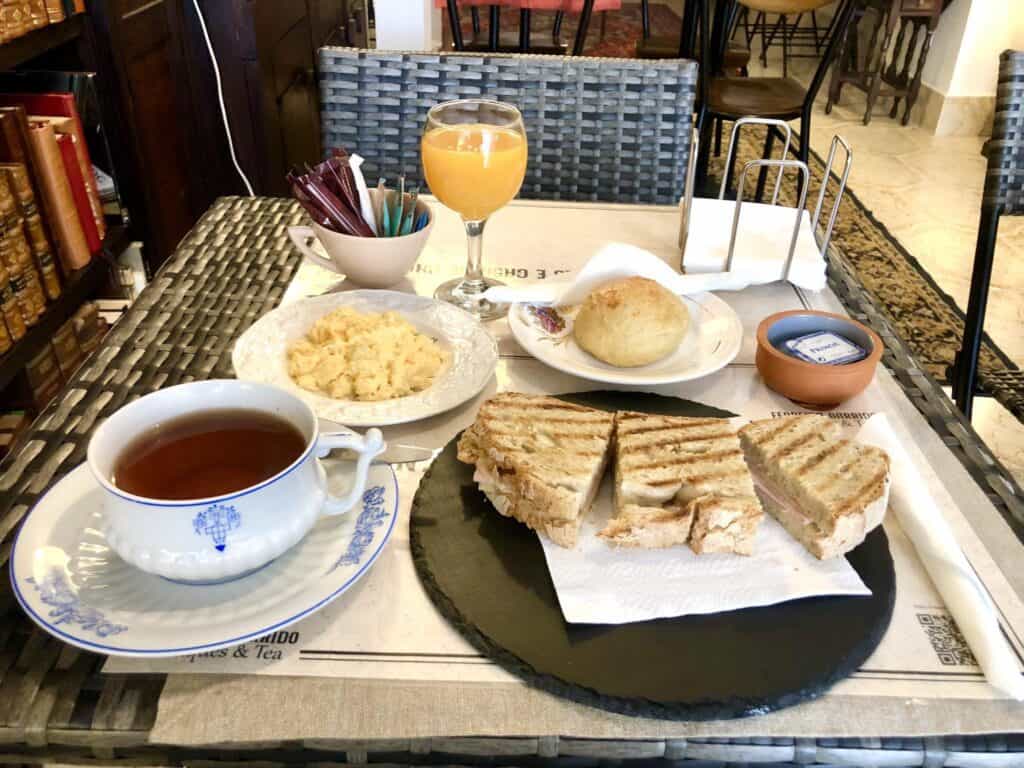
This one confuses so many people, but it’s actually very simple. Torrada is just toasted bread, often served with butter. Some places may add a few tomato slices, but the key point is that there is no second slice of toast on top.
That’s when it becomes a tosta!
A tosta is a toasted sandwich. You can find fillings like queijo (cheese), fiambre (ham), or the classic tosta mista (ham and cheese toastie).
Some of the most popular café toasties you’ll see in Portugal are:
Tosta de frango – chicken toastie
Tosta de atum – tuna toastie
Tosta de delícias do mar – seafood stick toastie
These often come with a creamy filling, usually made with mayonnaise.
Lunch & Dinner
Moving on to lunch (o almoço) and dinner (o jantar), you might find yourself in a restaurant, but not all places serving these meals use that name. Some opt for ‘snack-bar,’ a hybrid of café and restaurant, while cervejarias, originally beer-producing restaurants, offer a unique dining experience.
Understanding Menus
In Portugal, the menu is often referred to as a lista. Take your time to explore the items, whether the traditional bacalhau à Brás or the iconic pastel de nata. Familiarise yourself with common menu sections, such as entradas (appetisers) and prato do dia (daily special).
As you peruse the menu, here are some common dishes you might encounter:
- Pica-pau: Small pieces of pork marinated in beer or white wine, fried in olive oil, often served with garlic, pickles, and piri-piri hot sauce.
- Moelas: Similar to pica-pau but made with chicken gizzard, tomato pulp, and paprika.
- Camarões: Shrimp, typically served boiled or fried.
- Caracóis: Snails, a popular summer dish, are often paired with an ice-cold beer.
- Bife à casa: House steak, often with an egg on top, accompanied by rice, fries, and salad.
- Francesinha: A famous sandwich born in Porto, featuring beef, ham, sausages, cheese, and a fried egg, with a distinctive hot sauce.
Vegetarians beware; it’s not always easy in Portugal!
🫒 Starters That Appear on the Table (And Are NOT Free)
Common Appetisers: A Prelude to Portuguese Feasts
Before your main course arrives, Portuguese meals usually start with enticing appetisers:
- Um cesto de pão: A basket of bread, sometimes accompanied by toasts and corn bread.
- Azeitonas: Olives, sometimes seasoned with olive oil, garlic, and oregano.
- Manteiga: Butter.
- Paté de atum or paté de sardinha: Tuna or sardine paté.
- Presunto: Prosciutto, sometimes paired with melon cubes.
- Queijos: Cheeses, sliced, cured or fresh, pressed into a round shape.
- Rissóis: Deep-fried pastries, commonly filled with shrimp or meat.
- Enchidos fumados: Smoked sausages like chouriços, morcelas, alheiras, or farinheiras.
And here’s a tip: Appetisers, also called aperitivos, often appear automatically on the table and are NOT free. If you don’t want them, simply say, “Pode levar as entradas” (You can take the appetisers) or “Não vamos querer entradas, obrigado” (We are not going to want appetisers, thank you).
🥦 Vegetables as Side Dishes in Portugal
In Portuguese restaurants, vegetables aren’t always automatically included with your main dish. Many traditional meals focus on the protein (fish or meat) with potatoes, rice, or salad, and vegetables often need to be ordered separately. But the options here may be less interesting than expected.
Having a serving of steamed or boiled veg such as green beans or brocolli for insantance are not commonly found. You’ll be greeted with (maybe some potatoes or carrots). Cooked veg is normally served in soup.
What’s popular here, when it comes to veg as a side, are salads with lots of fresh vegetables.
But if you’re set on trying for the cooked variety, look for options like “legumes cozidos” (boiled vegetables)
You can ask: “Pode trazer legumes a acompanhar, por favor?” This is such an important thing to know that I’ve made a full lesson about it – because it surprises nearly everyone at first! Check out legumes ou vegetais?
🧾 Essential Portuguese Restaurant Phrases
| Portuguese | English |
|---|---|
| A ementa, por favor | The menu, please |
| O que recomenda? | What do you recommend? |
| Sem… | Without… |
| Sou vegetariano/a | I am vegetarian |
| A conta, por favor | The bill, please |
Payment
Wondering how to ask for the bill in Portuguese? Simply say: “A conta, por favor.” This phrase ensures a seamless ending to your dining experience.

Depending on the establishment, you may run into different payment and seating practices. In some places, you might pay first at the counter (pré-pagamento) or settle the bill with the waiter at the end. Be prepared for both scenarios.
🇵🇹 Portuguese Restaurant Etiquette
- The bread and olives are rarely free
- Not every place accepts card payments, so make sure you ask first or find the nearest ATM/Multibanco
- Tipping is not obligatory, nor is there a “correct” amount. Give whatever amount you wish, and if you want. Some leave no tip, while others leave 1€ or 2€ on the table. Exceptional service or fancier places might receive a higher tip of 5-10%. If paying by card, you can ask, “Posso incluir a gorjeta no pagamento com cartão, por favor?” (Can I add a tip to the card payment, please?) However, this service will only be available in limited places.
Conclusion
Ordering food in Portuguese doesn’t have to be stressful. With just a few key phrases like queria…, a conta, por favor, and an understanding of how Portuguese cafés and restaurants work, you’ll feel far more confident eating out in Portugal – and enjoy the experience much more.
Related Posts for Further Reading
Have a Patreon subscription? ☕
If you’re an active supporter on any of my Patreon tiers (starting with Meia-de-Leite), you get access to a printable PDF containing all the vocabulary from this post.